Table of Contents: Definition – Adobe
“Adobe”
Pronunciation: /əˈdoʊbi/ (uh-DOH-bee)
Part of Speech: Noun
Adobe Definition (Architectural Context)
A natural building material composed of earth, often mixed with water and an organic material like straw or manure. It is traditionally formed into bricks, which are then air-dried rather than fired in a kiln. The material can also be used to build monolithic (single-piece) walls. This construction method has been used for millennia worldwide. The resulting structures are known for their excellent thermal mass, which helps keep interiors cool in summer and warm in winter.
Origin of the Word “Adobe”
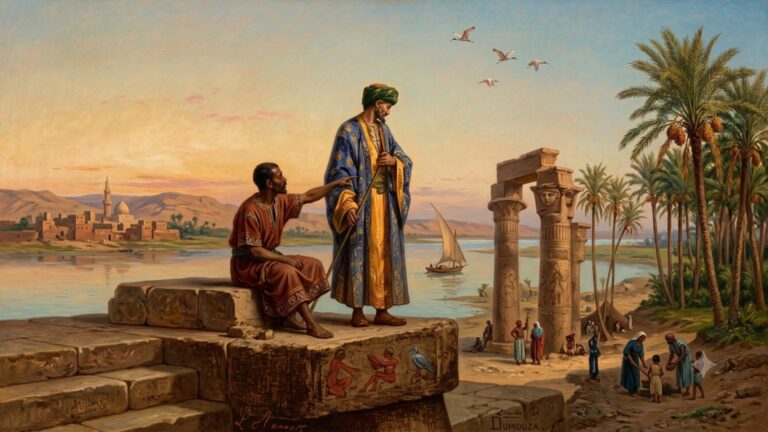
The word entered English via Spanish, which adopted the term from Arabic. The Arabic word al-ṭūb (الْطُوب) means “the brick.” This word itself can be traced back to the Ancient Egyptian hieroglyph $\text{db.t}$, also meaning “mud brick.”
Examples:
General Use: “In addition, the traditional house features thick walls made of the sun-dried material.”
Historical Context: “Similarly, early civilizations in Mesopotamia and the Andes used this simple, accessible material extensively.”
Construction Context: “Consequently, straw is added to the clay mixture to help prevent cracking as the material dries.”
Conservation Context: “Moreover, specialized methods are required to protect the walls from erosion caused by heavy rain.”
Vocabulary and Language Resources
Terms Related to Adobe
- Rammed Earth (Tampia): A similar building technique where damp earth is compressed into forms, for example.
- Wattle and Daub: A construction method using woven lattices (wattle) covered with a mud mixture (daub).
- Thermal Mass: The material’s ability to absorb and store heat energy effectively.
- Kiln: An oven used to fire ceramics or brick, contrasting with this sun-dried method.
- Lascaux: The site in New Mexico where the oldest surviving house in North America is made of earth.
- Pisé: The French term for rammed earth construction.
Etymology
Adobe: From Spanish, ultimately from Arabic al-ṭūb (the brick).
Synonyms
Mud brick, sun-dried brick, earth block, clay brick.
Antonyms:
Fired brick, concrete, stone masonry, wood frame.
Thesaurus
Brick, block, clay, earth, material, composite, building material.
Adobe Historical & Cultural Context
This is one of the oldest building materials on Earth. It was a primary construction material in the Fertile Crescent, ancient Egypt, and Mesoamerica. The Spanish introduced the term and the practice across the Americas. The material is common in arid and semi-arid regions where wood is scarce and sun is abundant for drying. Its use continues today due to its environmental sustainability and low cost.
Principles or Key Aspects of Adobe:
- Sustainability: The material is locally sourced and requires very little energy for production.
- Workability: It is easily mixed, molded, and applied using simple tools and labor.
- Thermal Regulation: The thickness and density of the walls provide natural cooling and heating.
- Water Vulnerability: It must be protected from direct, prolonged exposure to rain and groundwater.
- Compressive Strength: It has excellent load-bearing capabilities when dry, but poor tensile strength.
Ethical Considerations for Adobe.
- Seismic Vulnerability: Unreinforced structures are highly susceptible to damage during earthquakes.
- Modern Relevance: Promoting its use offers a low-cost, green alternative to industrial materials globally.
- Heritage: Preserving existing historical earth-built structures is vital for cultural heritage.
- Material Analysis: Scientific analysis of ancient earthen structures provides data on historical soil use.
Relevance to Ancient Worlds
The material is crucial for understanding ancient worlds because it:
- Defined Cities: The great cities of Mesopotamia and the Indus Valley were largely built with this material.
- Shows Technology: Its ancient use demonstrates early mastery of construction using available natural resources.
- Indicates Environment: Its prevalence confirms the historical ecology of arid regions.
- Preserves Records: Many clay tablets and scrolls survived because they were stored in dry earthen structures.
- Illustrates Housing: It was the primary material for the homes of vast numbers of ancient peoples worldwide.