Table of Contents: Definition – Adyton
“Adyton”
Pronunciation: /ˈædɪtɒn/ (AD-ih-ton)
Part of Speech: Noun
Adyton Definition (Architectural and Religious Context)
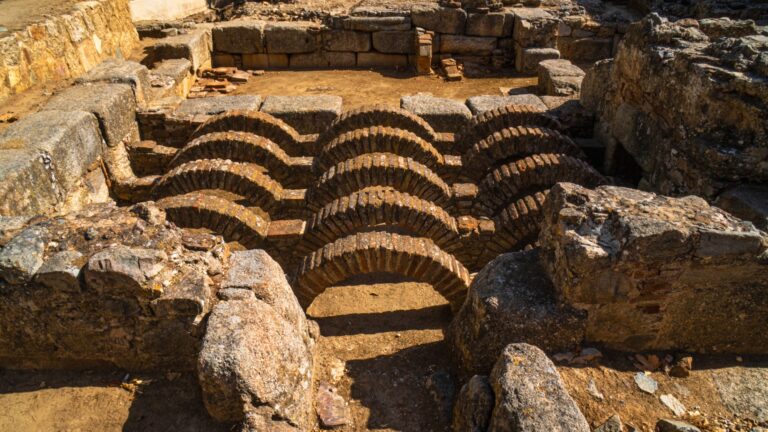
A small, innermost chamber or sanctuary in an ancient Greek temple. It was considered the most sacred area and was forbidden to all but the priests, priestesses, or oracular figures associated with the cult. Unlike the naos (main cella), the space was not typically used for public viewing of the cult statue. Instead, it was often the site of the oracle, a secret rite, or the placement of sacred objects. The most famous example was in the Temple of Apollo at Delphi.
Origin of the Word “Adyton”
The word comes directly from the ancient Greek adyton (ἄδυτον). The literal meaning is “not to be entered” or “inaccessible.” It is derived from the negative prefix a- (un-, not) and dyein (to enter, to plunge). The name perfectly describes the restricted, hidden nature of the chamber.
Examples:
- General Use: “In addition, the high priestess retired to the dark, isolated chamber to receive the prophecies.”
- Historical Context: “Similarly, the secrecy surrounding the inner room contributed to the immense power of the oracle.”
- Archaeological Context: “Consequently, excavators focused on the deeper floor levels of the inner room to search for offerings.”
- Religious Context: “Moreover, only the Pythia was permitted to cross the threshold into the innermost area.”
Vocabulary and Language Resources
Etymology
Adyton: From Greek a- (not) + dyein (to enter).
Synonyms
Inner sanctum, holy of holies, restricted chamber, secret shrine, inner sanctuary.
Antonyms:
Naos (main public chamber), Pronaos (temple porch), Agora (public marketplace).
Thesaurus
Sanctuary, shrine, recess, inner area, chamber, retreat, holy place.
Terms Related to Accession
- Naos (Cella): The main room of the temple where the cult statue was housed, for example.
- Opisthodomos: The rear room of a temple, often used as a treasury, that did not communicate with the naos.
- Oracle: A person or agency considered to be a source of prophetic counsel, often located in the innermost room.
- Temenos: The sacred enclosure or precinct surrounding the temple complex.
- Cult: The system of religious worship and ritual associated with a particular deity.
- Propylaea: The monumental gateway entrance to a sanctuary.
Adyton Historical & Cultural Context
The concept of a severely restricted inner chamber was a feature of many ancient religious traditions, not just Greek. However, the most famous structure was at Delphi, where the priestess known as the Pythia delivered her prophetic messages. The secrecy and inaccessibility enhanced the mystery and authority of the oracle. The structure was typically small, dark, and sometimes sunken below the level of the main floor. The design reinforced the chamber’s spiritual separation from the outside world.

Principles or Key Aspects of Adyton
- Design: Often a small, rectangular space located at the furthest end of the naos, frequently with no direct entrance from the main room.
- Material: Built of the same stone as the rest of the temple, but its small size prevented large-scale decorative elements like friezes.
- Atmosphere: Its hidden, underground nature in places like Delphi was intended to create an atmosphere of mystery and awe.
- Iconic Example: The most significant surviving instance is found in the Delphic Sanctuary.
Ethical Considerations for Adyton
- Interpretation: Archaeologists must be careful not to speculate wildly about the secret rituals performed within the chamber.
- Preservation: Due to the often-sunken or underground nature of the chamber, it can be vulnerable to water damage and collapse.
- Cultural Secrecy: The privacy of the ancient religious practices must be respected in modern interpretation.
- Contamination: The discovery of ritual deposits within the floor layers must be handled with extreme care.
Relevance to Ancient Worlds
The structure is crucial for understanding ancient worlds because it:
- Reveals Religious Belief: It highlights the ancient distinction between public worship and secret, esoteric rites.
- Explains Oracles: It provides the physical location and architectural setting for the most powerful oracular centers.
- Shows Priestly Power: The restriction of access demonstrates the high status and exclusive knowledge of the priesthood.
- Informs Temple Design: It is a key architectural feature defining the sacred core of some Greek temples.
- Aids Study: The rare, small finds recovered from the floor often reveal details about previously unknown religious practices.