Table of Contents: Definition – Aedicule
“Aedicule”
Pronunciation: /ˈiːdɪkjuːl/ (EE-dih-kyool)
Part of Speech: Noun
Aedicule Definition (Architectural Context)
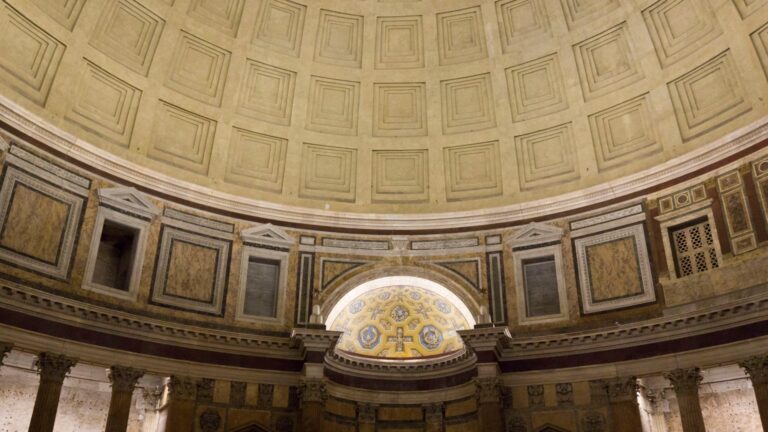
An aedicule is a small shrine or architectural framing device typically consisting of two columns or pilasters supporting a pediment, often with a base below. In Roman contexts, it was primarily used as a miniature architectural façade to frame a niche, statue, or window. It symbolizes a building, specifically a temple (aedes), in small form. It was used in both religious settings (as a portable shrine or to frame a cult statue) and secular architecture (to provide emphasis or hierarchy to a doorway).
Origin of the Word “Aedicule”
The word comes from the Latin term aediculum. This is the diminutive form of aedes, which means “temple” or “house.” Thus, it literally means “little house” or “little temple,” perfectly describing its miniature, temple-like appearance.
Examples:
- Religious Context: “In addition, the small aedicule within the private home housed a statue of the family’s household gods.”
- Monumental Context: “Similarly, the inscription was placed within a decorative frame on the massive triumphal arch.”
- Architectural Context: “Consequently, the structure used two columns and a triangular pediment to give importance to the window.”
- Curatorial Context: “Moreover, archaeologists found a portable terracotta shrine at the site of the ancient Roman fort.”
Vocabulary and Language Resources
Etymology
Aedicule: From Latin aediculum, the diminutive of aedes (house, temple).
Synonyms
Shrine, niche, tabernacle, canopy, miniature temple, architectural frame.
Antonyms:
Temple (aedes – full-sized temple), Basilica (large public building), Forum (public square).
Thesaurus
Frame, niche, recess, shrine, canopy, structure, enclosure.
Terms Related to Aedicule
- Pilaster: A rectangular column that projects slightly from a wall, often used in the structure’s frame, for example.
- Pediment: The triangular gable crowning the two sides, often featuring relief sculpture.
- Column: The vertical support, typically in the Corinthian or Composite order.
- Naos (Cella): The main sanctuary of a full-sized temple, which the small structure miniaturizes.
- Lararium: A small shrine in a Roman house dedicated to the Lares (household gods), often taking the form of the structure.
- Niche: A shallow recess in a wall, where the structure is often set.
Aedicule Historical & Cultural Context
This form was derived from Greek architecture but was extensively adopted and standardized by the Romans. It served as a powerful rhetorical device. By using the familiar facade of a temple, Romans could confer sacredness, dignity, or imperial authority upon any object or person framed within it. It was ubiquitous, found in private homes (as lararia), public markets, colossal funerary monuments, and even painted onto walls as a decorative motif (e.g., in Pompeii).

Principles or Key Aspects of Aedicule
- Miniature Temple: Functions as a symbol, transferring the religious gravity of a temple to a specific focal point.
- Framing Device: Its primary structural and visual role is to highlight and compartmentalize an important element.
- Material Versatility: Constructed from marble, stone, terracotta, stucco, or even just painted onto plaster.
- Hierarchical Marker: Used to emphasize the most important figures in a sculptural group or the highest-ranking windows/doors on a façade.
- Portability: Smaller versions allowed for personal religious worship and travel shrines.
Ethical Considerations for Aedicule
- Context Loss: Portable examples are often separated from their original location, losing crucial information about the specific cult or use.
- Restoration: Due to their small scale and decorative nature, they are frequently over-restored or incorrectly reconstructed.
- Material Value: Examples in high-value marble or containing bronze statues are often targets for looting.
- Interpretation: Understanding the structure’s use helps interpret the private religious life and ancestor veneration practices of the Romans.
Relevance to Ancient the World
The Aedicule is crucial for understanding ancient worlds because it:
- Reveals Private Cult: Its presence in homes offers direct evidence of domestic religious practices and ancestor worship.
- Defines Façades: It standardized the architectural language used to decorate major public and imperial buildings across the empire.
- Illustrates Design: It shows the Roman preference for modular, repeatable, and easily recognizable architectural elements.
- Informs Sculpture: It provides the original context for countless small Roman statues and busts of deities or emperors.
- Links Faith and State: It demonstrates how the language of sacred architecture was adopted to legitimize secular and imperial displays.