“Alabaster”
Pronunciation: /ˈæləbæstər/ (AL-uh-bas-ter)
Part of Speech: Noun
Quick Definition: A fine-grained, translucent form of gypsum or calcite, prized since antiquity for sculpture and ornamentation.
General Use: “The ancient Egyptians often used Alabaster for canopic jars and funerary vessels due to its soft texture and pale appearance. Consequently, it became associated with purity.”

Canopic Jars – These monumental funerary vessels were frequently carved from Alabaster in ancient Egypt. Their smooth, white surface perfectly suited the ritualistic preparation of the deceased.

The Faking of Marble – Roman artisans often used the cheaper, easier-to-carve Alabaster for interiors or non-structural elements. They intentionally treated it to resemble expensive marble, hiding its true identity.
Solubility Test – The two main types of Alabaster can be easily distinguished by a simple acid test. Calcite alabaster will violently bubble (react to acid), while gypsum alabaster will not, making identification monumental.
Did you know?
The two forms of Alabaster—gypsum and calcite—differ significantly in chemical composition and hardness. Calcite alabaster, the form used in ancient Egypt and the Near East, is slightly harder and chemically identical to marble. Conversely, gypsum alabaster, commonly used in medieval Europe, is soft enough to be scratched with a fingernail. This makes the mineral distinct from marble.
Alabaster Definition (Primary Context)
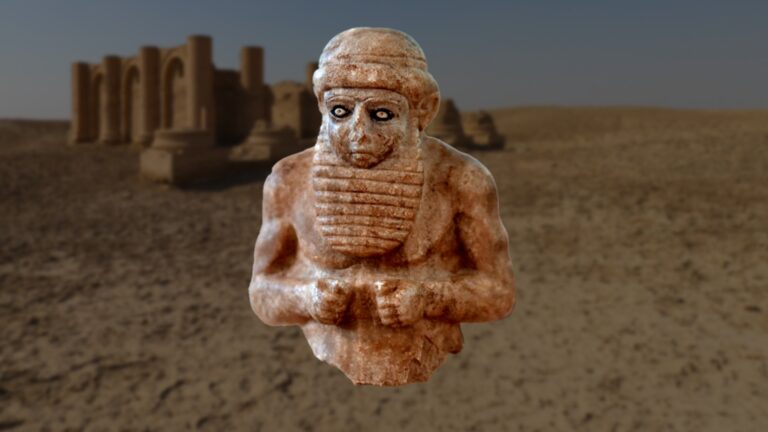
Alabaster is a mineral term applied to two chemically distinct varieties of mineral that share a similar appearance and workability. Both are dense, fine-grained, and typically pale white or translucent. Gypsum alabaster is a hydrous sulfate of calcium. Conversely, calcite alabaster is a form of calcium carbonate. Both forms were highly valued by ancient cultures, especially the Egyptians and Greeks, for carving small statues and vessels.

Greek: alabastros (ἀλάβαστρος), possibly derived from the Egyptian word a-labaste, referring to vessels dedicated to the goddess Bast.

Gypsum (for one variety), Calcite (for the other variety), Oriental Alabaster, Satin Spar.

Granite, Basalt, Quartzite, (all hard igneous rocks).

Sculpting stone, Ornamental stone, Translucent mineral, Carving material.
Historical Context of Alabaster
The earliest and most extensive use of Alabaster was in ancient Egypt. Its local variety, calcite, was quarried extensively for building, ritual items, and statuary. Later, the Greeks and Romans used both calcite and gypsum forms for decorative applications. In medieval Europe, the gypsum variety became popular, particularly in England and Spain, for creating effigies and church altarpieces. Consequently, the material’s easy carving made it a favorite for detailed religious iconography throughout the Middle Ages.

Social Context of Alabaster
The accessibility and appearance of Alabaster dictated its social use. Its translucent quality means thin sections allow light to pass through. Therefore, it was sometimes used as an alternative to glass in small church windows in medieval Europe. In Egyptian and Near Eastern cultures, the white and light-reflecting nature of the stone made it symbolic of purity and light. This made it essential for religious and funerary objects. Furthermore, its smooth finish and cool touch were prized in luxury household items.
| Area of Influence | Significance and Impact |
| Ancient Egyptian Funerary Rites | The pale, pure color of Alabaster symbolized the clarity and sanctity required for housing the organs or the ka (spirit). |
| Chemical Differentiation | The calcite version reacts to acid; conversely, the gypsum version does not, requiring distinct conservation methods for each type of Alabaster. |
| Architectural Use | In some large cathedrals, thin sheets of Alabaster were used in place of expensive glass, creating a soft, luminous quality. |
| Trade and Economy | High-quality European Alabaster was a significant export item during the 14th to 16th centuries, supporting regional artistic workshops. |
Terms Related to Alabaster
The study of Alabaster involves understanding its chemical makeup and artistic application. This provides essential context for differentiating its types and recognizing its common uses. This provides a clearer view of the geological framework surrounding the material.

| Term/Concept | Description and Relevance |
| Gypsum | The soft, hydrous calcium sulfate mineral that makes up the common European variety of Alabaster. |
| Calcite | The calcium carbonate mineral that makes up the harder, ancient Egyptian variety, often called Oriental Alabaster. |
| Mohs Scale | The scale of mineral hardness. Gypsum Alabaster ranks at 2, while calcite ranks at 3, showing their relative softness. |
| Entablature | Although not a primary structural material, Alabaster was sometimes used for decorative panels within a larger architectural entablature. |
| Translucency | The light-passing quality of the mineral when carved thinly. This made Alabaster highly desirable for decorative lamps. |
| Hydration | The presence of water molecules in the chemical structure of gypsum Alabaster is a key defining factor. |
Sources & Credits
Sources
- Britannica, T. Editors of Encyclopaedia. “Alabaster.” Encyclopedia Britannica. [Definition site]
- Egyptian Museum, Cairo. “Funerary Objects and Ritual Vessels.” Permanent Collection Notes. [Museum site]
- Ogden, J. M. “Ancient Jewellery.” University of California Press, 1992. [Historical source]
- Department of Earth Sciences, Natural History Museum, London. “Gypsum and Calcite Minerals.” Geological Fact Sheet. [Government institutional body/definition site]
- Nicholson, P. T., and I. Shaw. “Ancient Egyptian Materials and Technology.” Cambridge University Press, 2000. [Historical source]