Table of Contents: Definition – Amphora
“Amphora “
Term: Amphora (plural: Amphorae or Amphoras)
Pronunciation: /ˈæmfərə/ (AM-fuh-ruh)
Part of Speech: Noun
Amphora Definition:
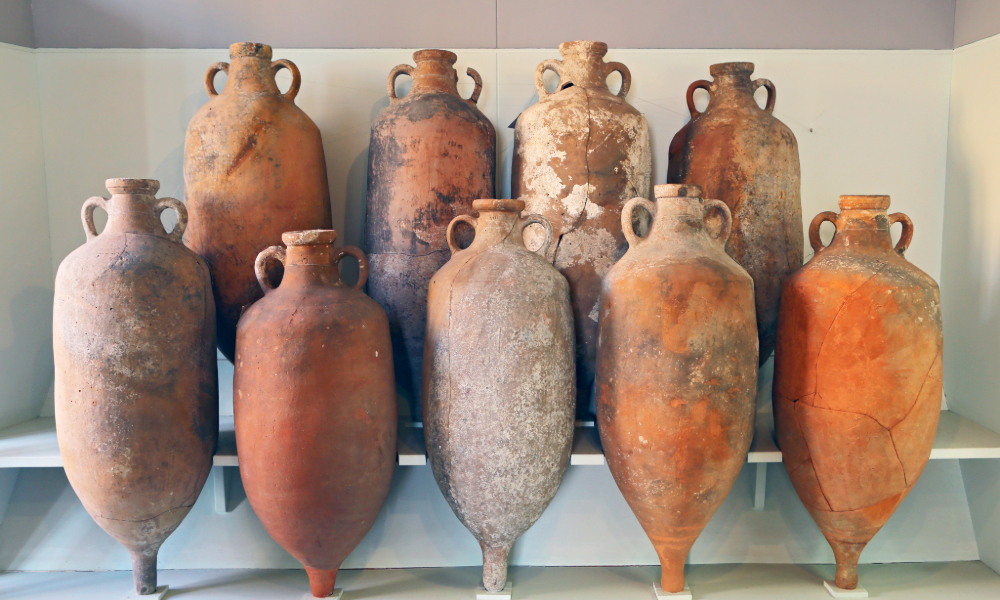
An amphora is an ancient vessel, typically ceramic, characterized by two vertical handles, a narrow neck, and an oval or elongated body that often tapers to a pointed base. Used extensively throughout the ancient Mediterranean world, particularly by the Greeks and Romans, the vessel served primarily as storage and transport containers for various liquid and dry goods, most notably wine, olive oil, grains, and preserved foods. Beyond their utilitarian function, elaborately decorated jars were also valued as artistic objects, used as prizes, and sometimes as funerary urns or grave markers.
Origin of the Word “Amphora”:
The term “amphora” originates from the Greek word amphoreus (ἀμφορεύς), meaning “carried on both sides,” referring to the vessel’s two handles. This term is a shortened form of amphiphoreus. The Latin adaptation of the Greek word is amphora.
Examples:
General Use: “Archaeologists discovered several intact amphorae in the shipwreck.”
Historical Context: “The shape and fabric of an amphora can often indicate its origin and the period in which it was produced.”
Commercial Context: “Amphorae were essential for the widespread trade of wine and oil in the ancient Mediterranean.”
Art History Context: “Painted amphorae provide valuable insights into ancient Greek mythology, daily life, and artistic styles.”
Vocabulary and Language Resources
Related Terms
- Amphoriskoi: Small vessel.
- Neck Amphora: A jar where the neck meets the body at a sharp angle.
- Belly Amphora (One-piece Amphora): A style of the jar where the neck and body form a continuous curve.
- Panathenaic Amphora: A specific type of neck amphora, painted in black-figure style and given as prizes at the Panathenaic Games, containing olive oil.
- Pelike: A type of belly amphora with a rounded, sagging body, often used for liquids like perfume.
Etymology
From Greek amphoreus (“carried on both sides”), from amphi- (“on both sides”) + pherein (“to carry”).
Synonyms
Storage jar, transport vessel.
Thesaurus
Container, vessel, jar, pot, receptacle.

Amphora Historical & Cultural Context:
These vessels saw use from the Neolithic era, flourishing in the Mediterranean Bronze and Iron Ages. Their forms and dimensions differed by contents and origin, yielding distinct regional styles crucial for tracing ancient trade and cultural links. Plain, “coarse” types were standard for sea transport, often with pointed bases for ship and sand stability. Ornate examples, especially from ancient Greece, featured black-figure and red-figure painting depicting myths, athletics, and daily life. Studying these containers and their stamps/inscriptions reveals ancient economies, trade routes, and site dating. Though Romans largely replaced them with wooden barrels for transport, these ceramic jars persisted for household and decorative purposes.
Principles or Key Aspects of the Word Amphora :
- Functionality: Primarily for storage and transportation of goods.
- Standardization: Some degree of standardization in size corresponded to units of measure (e.g., the wine jars).
- Regional Variation: Distinct shapes and clay fabrics can often identify the origin of an amphora.
- Decoration: Many jars, especially those for wine or prizes, were elaborately painted.
- Ubiquity: Shards of vessels are among the most common finds at Mediterranean archaeological sites.
Ethical Considerations for Amphora:
- Provenance: Establishing the origin and history of ownership is crucial for ethically studying and displaying amphorae.
- Conservation: Proper conservation is essential to preserve these fragile historical artifacts.
- Interpretation: Understanding the cultural and economic significance of amphorae in their original context.
Relevance to Ancient Worlds
- Ancient Trade: These containers are vital markers for understanding commercial exchange networks and the routes of ancient maritime trade across the Mediterranean and beyond. Their presence and distribution reveal the movement of goods and the interconnectedness of ancient economies.
- Daily Life: The discovery of these vessels at habitation sites provides tangible evidence of how ancient peoples stored and utilized various commodities, shedding light on their dietary habits, agricultural practices, and household management.
- Art and Iconography: Decorated examples, often adorned with intricate painted scenes depicting mythology, rituals, and everyday activities, offer invaluable insights into the religious beliefs, social customs, and artistic styles prevalent in ancient cultures.
- Chronology: The evolution of these vessels’ shapes, sizes, and decorative motifs over time provides a crucial tool for archaeologists to establish relative and sometimes absolute chronologies for archaeological sites and the artifacts found within them.
- Technology: The ability of ancient potters to consistently produce large quantities of these durable ceramic containers, often to standardized sizes and forms, underscores their sophisticated understanding of materials science, kiln technology, and mass production techniques.