Table of Contents: Definition – Apse
“Apse”
Pronunciation: /æps/ (aps)
Part of Speech: Noun
Apse Definition (Historical Context)
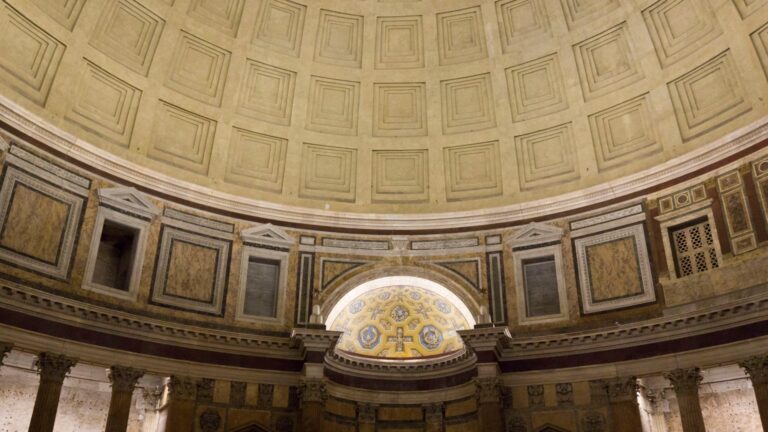
An Apse is a large, semicircular or polygonal recess in a building wall. It is typically vaulted or domed above the floor level. The apse is most often found at the eastern end of a Christian church or the end of a Roman basilica. This architectural feature terminates the building’s main axis. In religious structures, the apse usually houses the altar or the bishop’s throne.
Origin of the Word “Apse”
The word comes from the Latin term apsis. This word meant “arch” or “vault.” It was derived from the Greek hapsis (ἁψίς), meaning “loop” or “arch.” The term was first used to describe the curved niche in Roman basilicas.
Examples:
General Use: “In addition, the tour guide pointed out the elaborate mosaics decorating the apse.”
Architectural Context: “Similarly, the design called for three small windows high up on the wall of the apse.”
Historical Context: “Consequently, the earliest Christian churches adapted the form of the Roman basilica’s apse for their ritual needs.”
Conservation Context: “Moreover, conservation specialists spent months cleaning the frescoes inside the apse.”
Vocabulary and Language Resources
Terms Related to Apse
- Nave: The central and principal part of a church building, for example.
- Aisle: The lateral division of a church parallel to the main nave.
- Basilica: A large public Roman building often used for law courts and meetings.
- Transept: The cross-arm section of a church that intersects the nave.
- Altar: The table or platform where religious rites are performed, usually in the apse.
- Vault: An arched structure, typically of masonry, forming a ceiling or roof.
Etymology
From Latin apsis (arch), from Greek hapsis (arch, loop).
Synonyms
Recess, niche, semi-dome, sanctuary (in a religious context).
Antonyms:
Narthex (entrance area), Vestibule (entry hall), Façade (front exterior).
Thesaurus
Alcove, cavity, terminal, curvature, segment, bend, end.
Apse Historical & Cultural Context:
The Apse originated in Roman secular architecture, specifically in the basilicas. Roman magistrates’ seats and statues of emperors were located there. The early Christian Church adopted this architectural form for symbolic reasons. The semicircular space was ideal for seating the clergy and placing the altar. This adaptation gave the apse its lasting religious function. It remains a defining feature of Byzantine, Romanesque, and Gothic church architecture.
Principles or Key Aspects of Apse:
- Visual Focus: Its curved shape draws the eye to the terminal point of the building.
- Acoustics: The curvature often provides desirable acoustic qualities for liturgical chants.
- Symbolism: In churches, it symbolizes the heavenly or sacred focus of the worship space.
- Structural Role: The apse often provides structural support at the building’s end.
- Orientation: Most early Christian apses were oriented toward the east (Jerusalem/sunrise).
Ethical Considerations for Apse:
- Religious Significance: The apse must be treated with respect due to its highly sacred function in many faiths.
- Restoration: Restoration of the original dome, frescoes, or mosaics must adhere to strict guidelines.
- Structural Integrity: Due to age and vaulting, apses often require specialized conservation work.
- Archaeological Context: Study of the apse placement reveals early liturgical practices and church orientation.
Relevance to Ancient Worlds
The Apse is crucial for understanding ancient worlds because it:
- Shows Roman Influence: Demonstrates the direct lineage from Roman public buildings to Christian churches.
- Indicates Function: Identifying an apse in ruins helps determine if the building was a basilica or church.
- Highlights Religion: Its placement signifies the importance of the altar and clergy seating.
- Aids Chronology: Changes in apse design help date architectural periods and styles.
- Preserves Art: Many of the best-preserved ancient mosaics and frescoes are located within apses.