“Architrave”
Pronunciation: /ˈɑːrkɪtrəv/ (AR-ki-trahv)
Part of Speech: Noun
Quick Definition: The main beam or lintel resting directly across the tops of a column or pier.
General Use: “The sculpted frieze rested directly upon the plain surface of the Architrave in the Doric temple. Therefore, it was a fundamental supporting element.”

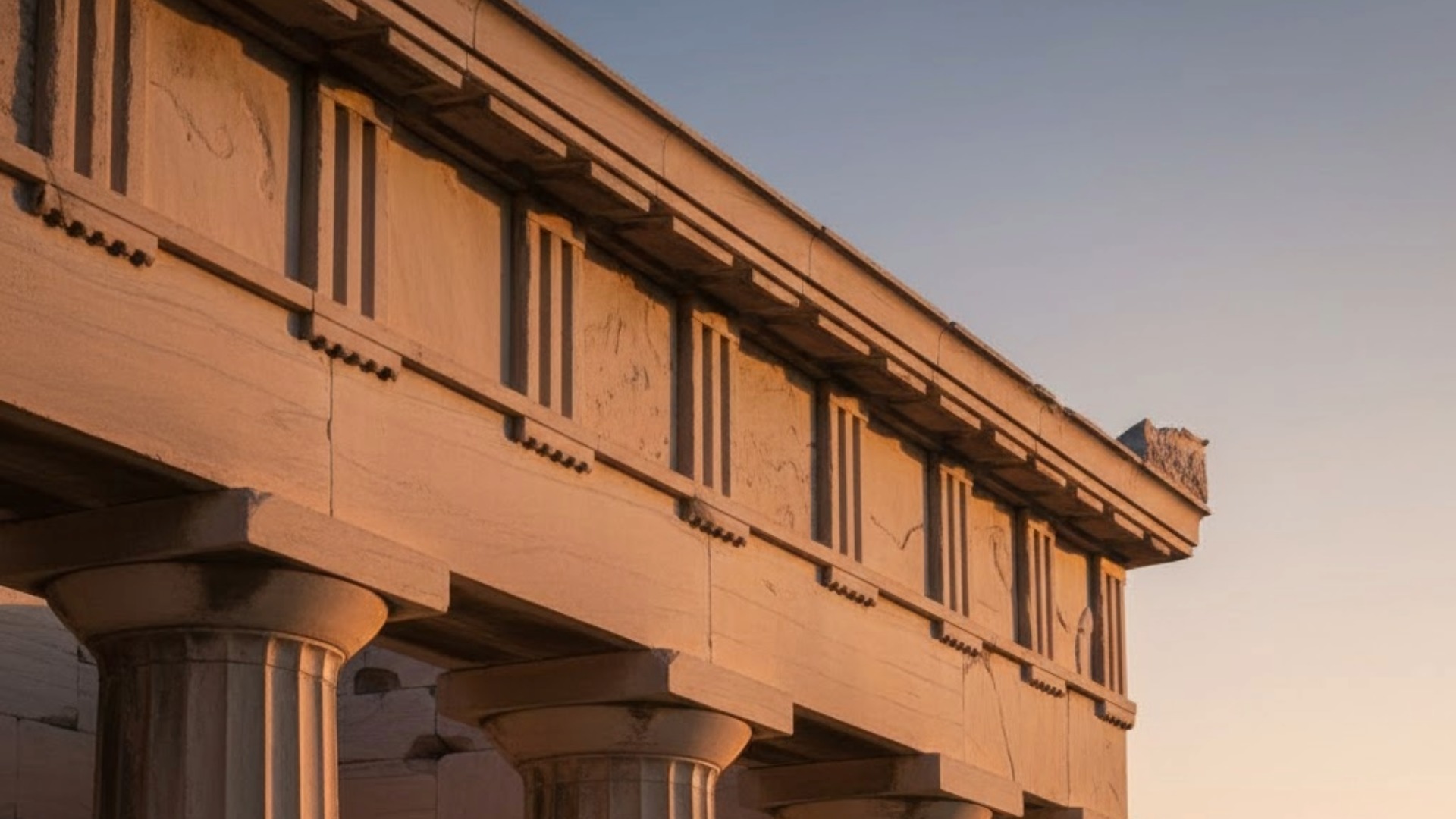
The Parthenon’s Metopes – The metopes and triglyphs of the Doric frieze sat directly above the supporting Architrave. This element provided a stable visual base for the high-relief sculpture.

The Missing Guttae – In some Ionic and Corinthian orders, the Architrave was left completely plain, hiding the underlying structural function. This simplified appearance was often a stylistic choice.
The Primary Load Bearer – Structurally, the Architrave is the most important element of the entablature. It transmits the weight of the entire roof and superstructure down onto the columns, making it critical.
Did you know?
The Architrave originated as a simple, massive stone or wooden beam. Its evolution shows how ancient builders refined simple load-bearing concepts. Furthermore, the treatment of the Architrave often distinguishes the various classical orders. Consequently, the Doric architrave is simple, whereas the Ionic and Corinthian versions are often subdivided into decorative bands.
Architrave Definition (Primary Context)
The Architrave is the lowest of the three horizontal members of the entablature in classical architecture. It is the main beam that spans the space between two columns or piers. Consequently, it acts as a primary load-bearing lintel. The entablature sits above the columns, and it also includes the frieze and the cornice. The design of the Architrave is strictly defined by the architectural order it belongs to. This makes it an essential characteristic for architectural analysis.

Italian: architrave, formed from Greek arkhi (chief) and Latin trabs (beam).

Lintel, Main Beam, Epistyle, Crossbeam.

Column, Capital, Pedestal, Base.

Rafter, Joist, Spandrel, Entablature.
Historical Context of Architrave
The concept of the Architrave is derived from early timber construction. When Greek builders began using stone for temples, they translated the wooden beam form directly into massive stone blocks. This transfer of form defined the strength and spacing of columns. For example, in the Doric order, the triglyph and metope pattern above the Architrave dictated the rhythmic positioning of the columns below. Consequently, the use of large monolithic stones for the Architrave demonstrates the increasing engineering capability of Greek builders.
Social Context of Architrave
The size and material of the Architrave reflected the wealth and power of the city or patron sponsoring the building. Constructing a temple with enormous, single-piece marble architraves required immense resources and specialized labor. Therefore, the physical scale of the Architrave symbolized civic pride and religious devotion. Additionally, the plainness or ornamentation of this element conveyed aesthetic preferences tied to different social ideals, such as Doric austerity versus Ionic refinement.
| Area of Influence | Significance and Impact |
| Structural Engineering | The Architrave determined the maximum possible intercolumniation (column spacing) in ancient stone architecture. |
| Classical Order Definition | Its decoration, such as being plain (Doric) or having fasciae (Ionic), fundamentally separates the main classical styles. |
| Material Sourcing | Large single-block architraves necessitated specialized quarries and complex overland transport, demonstrating logistical prowess. |
| Visual Hierarchy | As the transition from vertical column to horizontal roof structure, the Architrave visually grounds the entire entablature. |
Terms Related to Architrave
The Architrave is part of the larger ensemble known as the entablature. Understanding its associated components provides essential context for classical temple design. This provides a clearer view of the architectural framework surrounding the classical orders.

| Term/Concept | Description and Relevance |
| Entablature | The entire horizontal superstructure resting upon the capitals, containing the Architrave. |
| Frieze | The middle member of the entablature, which rests directly on the Architrave. |
| Cornice | The uppermost and projecting section of the entablature, providing shelter and crowning the Architrave. |
| Capital | The top element of a column upon which the Architrave immediately rests, transferring the load. |
| Triglyph | The vertical tablet with three vertical grooves found in the Doric frieze directly above the Architrave. |
| Fasciae | The flat, horizontal bands used to decorate the surface of the Architrave in the Ionic and Corinthian orders. |
Sources & Credits
Sources
- Britannica, T. Editors of Encyclopaedia. “Architrave.” Encyclopedia Britannica. [Definition site]
- The Metropolitan Museum of Art (The Met). “The Orders of Classical Architecture.” Heilbrunn Timeline of Art History. [Museum site]
- Vitruvius, M. P. “Ten Books on Architecture (De Architectura).” Dover Publications, 1960. [Historical source]
- Department of Antiquities, Greece. “The Architecture of the Parthenon.” Hellenic Ministry of Culture. [Government institutional body/definition site]
- Curl, J. S. “A Dictionary of Architecture and Landscape Architecture.” Oxford University Press, 2015. [Definition site]