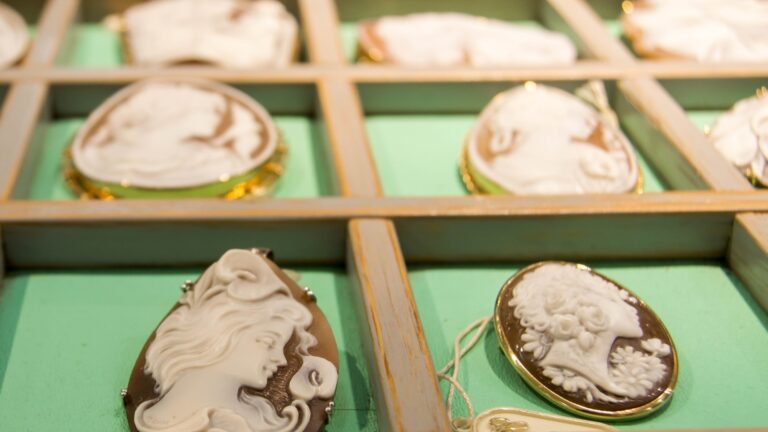
“Beadwork”
Pronunciation: /ˈbiːdwɜːrk/ (BEED-wurk)
Part of Speech: Noun
Quick Definition: The craft of decorating textiles, clothing, or objects by stitching small beads onto a fabric surface or by stringing them together to form a pattern.
General Use: “The intricate Lakota Beadwork on the traditional dress utilized hundreds of thousands of tiny seed beads. Consequently, this required exceptional skill and time to achieve the monumental geometric patterns.”

Micro-Mosaic – Historically, the finest examples of Beadwork, particularly the floral designs from the Great Lakes region or the detailed pictorial scenes on Iroquois items, represent a monumental form of textile micro-mosaic. Tiny glass beads are fitted together tightly, mimicking the appearance of painted or mosaic art.

A Global Trade Marker – The hidden economic significance of much 19th-century Beadwork lies in the beads themselves. The vast majority were produced in Venice or Bohemia, making the finished artwork a monumental marker of long-distance global trade and colonial influence.

Quillwork Precursor – Before the introduction of glass beads by European traders, many Indigenous North American cultures used quillwork—the flattened, dyed quills of porcupines—to decorate clothing. Beadwork largely replaced this earlier, monumental art form due to the superior color, uniformity, and abundance of the glass beads.
Did you know?
The earliest forms of Beadwork date to the Paleolithic era, utilizing natural materials like bone, teeth, and shell. These early beads were not just decorative; they served as potent amulets, status symbols, and objects exchanged in ritual. Therefore, the tradition of creating and wearing elaborate Beadwork is one of humanity’s longest-standing artistic practices.
Beadwork Definition (Primary Context)
Beadwork utilizes various techniques categorized by how the beads are affixed:
- Sewn Beadwork (Lazy Stitch, Spot Stitch): Beads are stitched directly onto a cloth or hide surface, often creating solid color fields (Lazy Stitch, typical of the Plains) or curvilinear, individual patterns (Spot Stitch, typical of the Great Lakes florals).
- Woven Beadwork (Loom Work): Beads are strung on warp threads and woven together using weft threads on a loom, resulting in rigid, flat bands used for belts, straps, or decorative strips.
- Stringing/Dangling: Beads are strung together and hung from the main garment or pouch to create fringe or kinetic decoration.
The complexity of the designs often served as a visual language, communicating the wearer’s clan, lineage, social status, and achievements.

English: Compound of bead (small piece of material pierced for threading) and work (the action or result of labor).

Bead Craft, Beading, Stringing, Quillwork (historical precursor).

Embroidery (using thread only), Appliqué (using cloth patches), Mosaic (using tesserae).

Craft, Adornment, Textile Decoration, Fine Art.
Historical Context of Beadwork
While ancient Beadwork primarily used natural materials, the introduction of tiny, uniform Venetian and Bohemian glass beads (known as seed beads) in the 17th and 18th centuries revolutionized the practice globally. This new material allowed for exponentially finer and more intricate designs. In North America, the 19th century is considered the golden age of Indigenous Beadwork, with distinct regional and tribal styles developing rapidly in response to trade and the need to assert cultural identity through monumental art.

Social Context of Beadwork
Beadwork is often considered women’s work in many Indigenous cultures, serving as a primary source of creative expression and economic exchange. The creation of a piece, often taking hundreds of hours, demonstrated the artisan’s patience, dedication, and skill. Therefore, Beadwork holds monumental value, often functioning as gifts exchanged in ceremonies, a key component of ceremonial regalia, and a profound record of cultural knowledge, ensuring that the finished work is both beautiful and meaningful.
| Area of Influence | Significance and Impact |
| Cultural Documentation | Specific colors, patterns, and motifs transmit traditional clan histories and cosmology. |
| Status and Wealth | The quantity and quality of the Beadwork on an item reflects the owner’s status and access to valuable trade goods. |
| Economic Exchange | Highly prized in trade networks, finished Beadwork was often exchanged for horses, food, or other valuable commodities. |
| Personal Identity | Items like belts, vests, and pouches are personalized by the wearer or artist. This provides a monumental expression of individual identity. |
Terms Related to Beadwork
The study of Beadwork requires specific terminology for its materials and techniques. This provides essential context for textile and material culture studies. This provides a clearer view of the technical framework surrounding the craft.

| Term/Concept | Description and Relevance |
| Seed Bead | Tiny, uniform glass beads imported from Europe. This is the primary material used in 19th-century Beadwork. |
| Lazy Stitch | A sewing technique. This involves laying down short rows of beads that create a slightly raised, ridged texture on the surface. |
| Spot Stitch | A sewing technique. This involves tacking down long strings of beads at intervals. This creates smooth, curvilinear, and floral designs. |
| Loom Work | The technique used to weave flat panels of Beadwork on a frame. This is commonly used for belts and straps. |
| Wampum | Shell beads, typically white or purple. This was used by northeastern tribes for ceremonial belts, predating and differing from glass Beadwork. |
| Quillwork | The earlier Indigenous North American decorative art. This used porcupine quills before the rise of glass Beadwork. |
Sources & Credits
Sources
- Gaffen, J. “Cross-Stitch and Crayon: The Feminization of Folk Art.” Museum of Civilization, 1996. [Historical source]
- Penney, D. W. “North American Indian Art.” Thames & Hudson, 2004. [Historical source]
- “Beadwork in the American West.” The Metropolitan Museum of Art: Collection Essays. [Museum site]
- Berlo, J. C., and R. B. Phillips. “Native North American Art.” Oxford University Press, 2014. [Historical source]
- National Museum of the American Indian (NMAI). “Beadwork: Visual Language and Cultural Exchange.” Curatorial Notes. [Museum site]