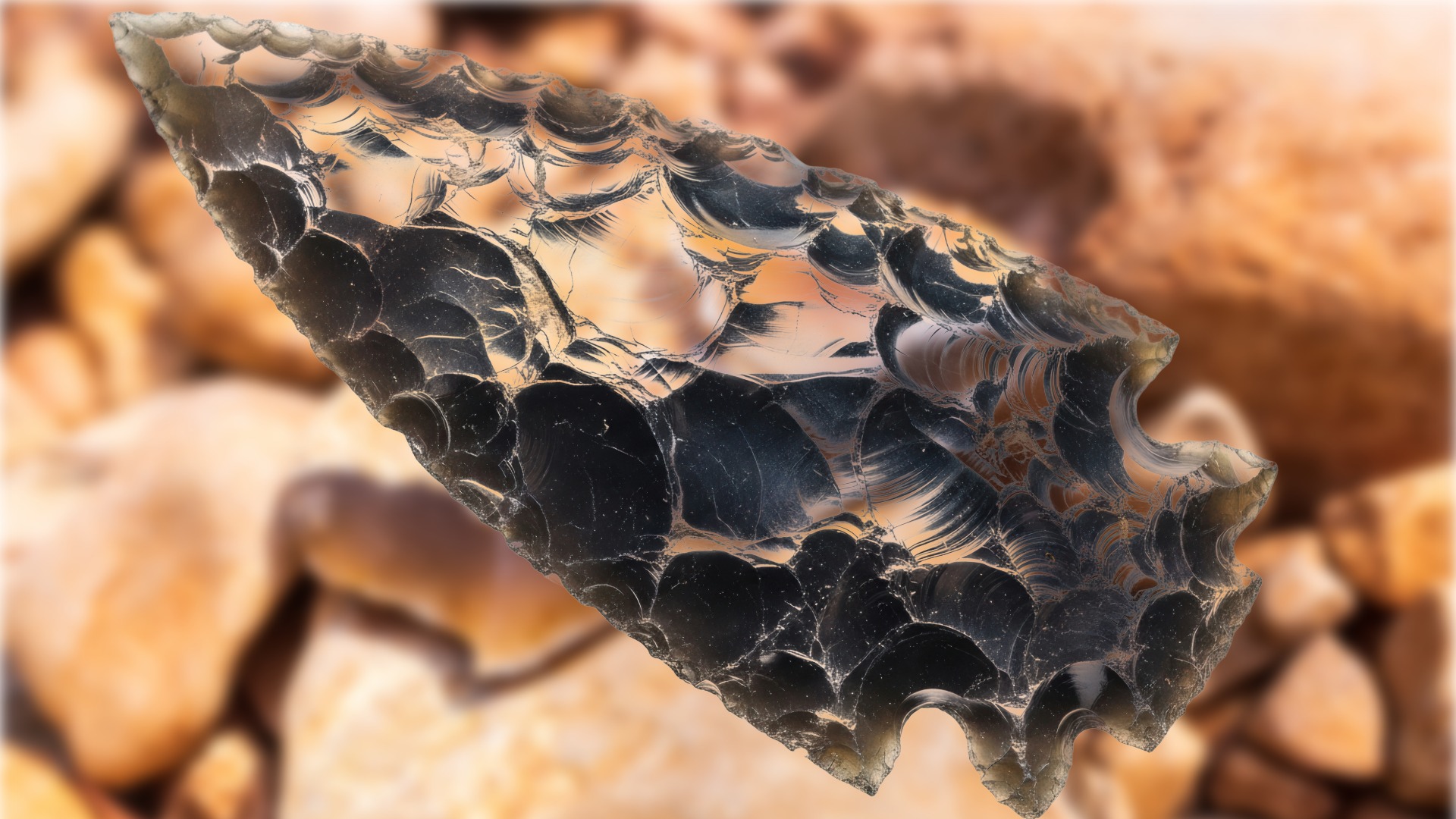
“Blade”
Pronunciation: /bleɪd/ (BLAYD)
Part of Speech: Noun
Quick Definition: A stone artifact, usually a flake, distinguished by its thin profile and a length that is at least double its width.
General Use: “The Late Paleolithic craftsman carefully struck the prepared core to detach a long, sharp Blade. Consequently, this highly standardized tool was immediately useful for cutting meat and sawing wood.”

The Solutrean Laurel Leaf – While not a true blade in the technical sense, the monumental thinness and precision of the Solutrean laurel-leaf points demonstrated the ultimate mastery of the lithic reduction process that produced blades.

Versatile Tools – The Blade was rarely used as a singular tool. Instead, it was a hidden, modular component. Many blades were hafted (set into a handle) or inserted as segments into sickle edges or compound spear points.
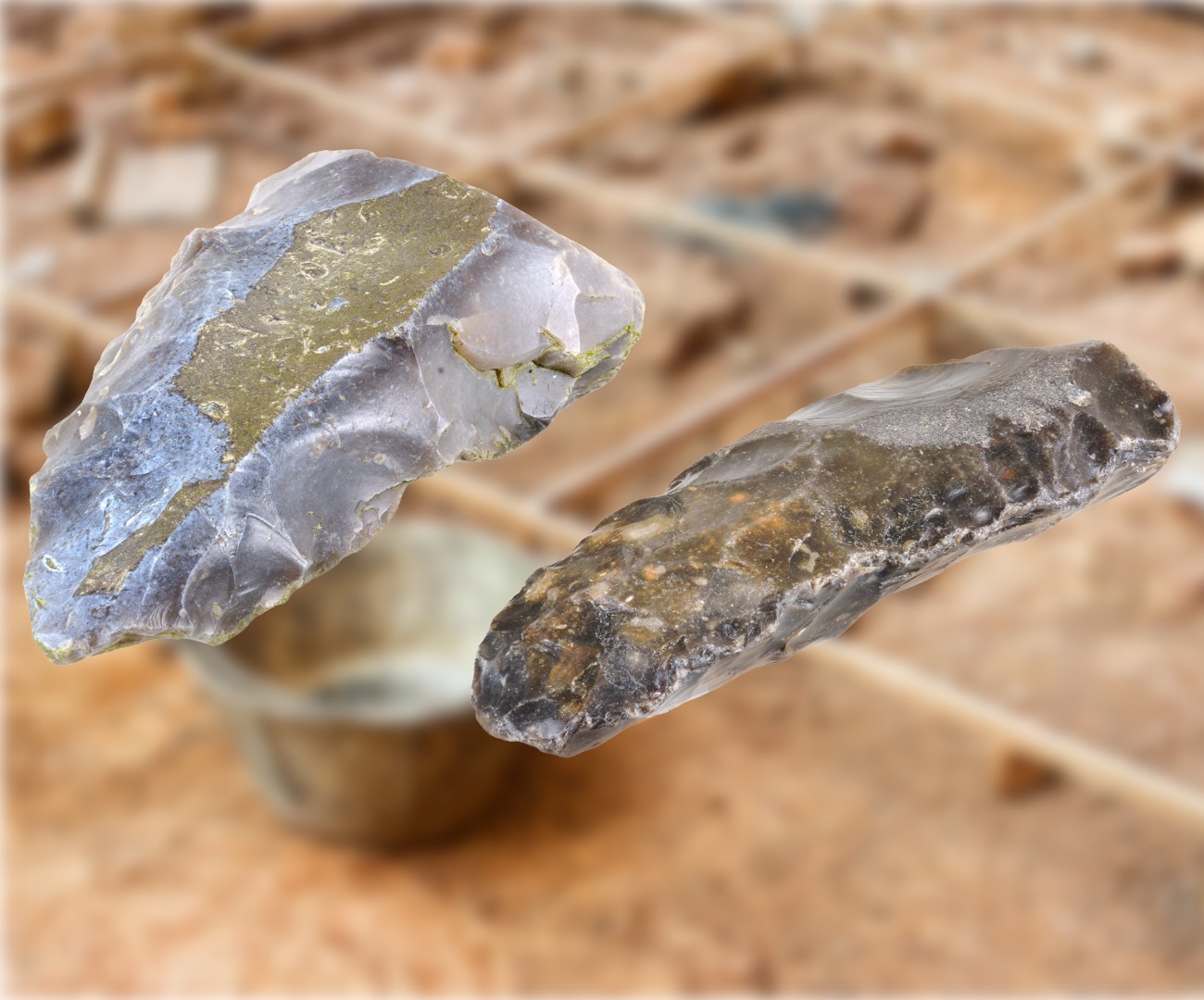
Standardization – The efficient, standardized production of a straight-edged Blade represented a monumental technological leap. This contrasts sharply with the variability of simple flakes, signaling a major advance in craft specialization.
Did you know?
The technique used to produce a Blade—often called the blade core technology—allowed ancient people to get the maximum amount of usable cutting edge from a piece of raw stone. This efficient use of material was crucial, especially when high-quality stone was scarce. Therefore, the adoption of blade technology marked a significant developmental phase in prehistoric toolmaking.
Blade Definition (Primary Context)
In lithic analysis, a Blade is a flake removed from a prepared core, meeting a precise geometrical definition: the length must be greater than or equal to twice the width. The sides are typically parallel, and the dorsal face often displays two or more parallel arrises (the lines where previous flakes were removed). This consistency indicates a highly controlled and sophisticated flaking technique. The resulting Blade provided a long, sharp, ready-made cutting edge superior to that of a simple, randomly shaped flake.

Old English: blæd or blæda, meaning “leaf,” “frond,” or “flat part of an oar,” referring to the thin, flat shape.

Flake (elongated type), Lamellar Flake, Knife (functional name), Cutting Implement.

Core (the source stone), Simple Flake (length less than twice width), Celt (ground stone tool).

Lithic Tool, Artifact, Cutting Edge, Implement.
Historical Context of Blade
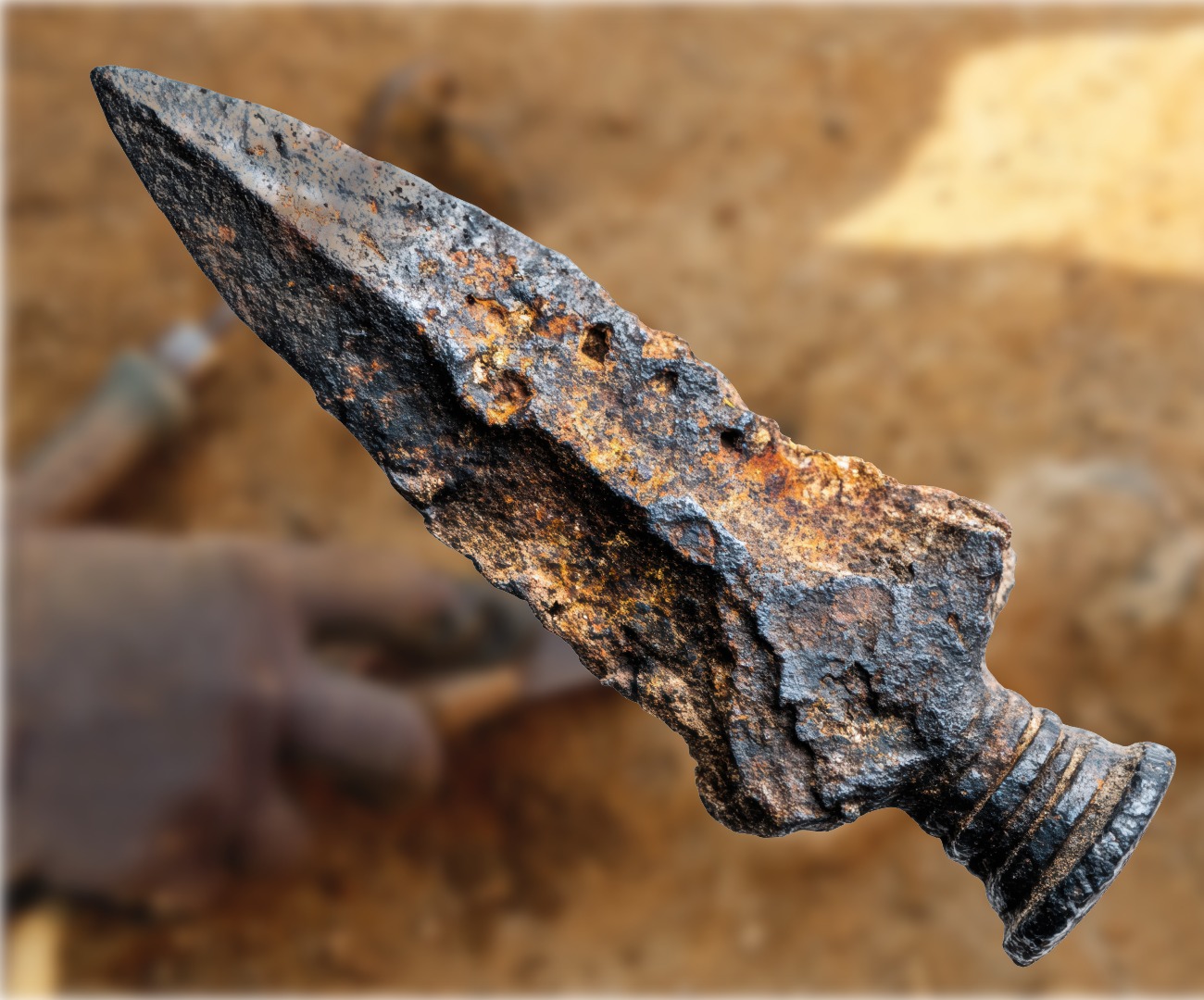
The earliest systematic production of true Blades began in the Upper Paleolithic period (roughly 40,000 to 10,000 years ago) and is particularly characteristic of European and Near Eastern traditions (e.g., Aurignacian, Solutrean). This marked the end of the Middle Paleolithic reliance on simple flake production (Mousterian). Later, Neolithic cultures refined the process further, producing huge numbers of microlithic blades for agricultural tools like sickles. This technology was also independently developed in the pre-Columbian Americas.
Social Context of Blade
The creation of a specialized Blade required considerable skill and knowledge of lithic physics. This suggests the rise of skilled, perhaps specialized, artisans in prehistoric groups. The efficiency of the technique meant that fewer raw materials were needed to supply a large group with tools. Therefore, this innovation likely contributed to population growth and the development of more complex, settled societies. The Blade provided a reliable, sharp, and consistent tool for everything from hunting to hide preparation.
| Area of Influence | Significance and Impact |
| Tool Efficiency | The method maximizes the ratio of cutting edge to the volume of raw stone. This makes the tool highly material-efficient. |
| Technological Skill | Manufacturing the object requires a prepared core and precise striking force. This implies a high degree of craftsmanship and training. |
| Composite Tools | The small, standardized version (microlith) allowed for the creation of complex tools. This included serrated sickles and harpoons from multiple blades. |
| Typological Dating | The specific shape and size changed over time. This makes it a key index fossil for dating Paleolithic and Mesolithic sites. |
Terms Related to Blade
The analysis of a Blade involves several terms related to the process of its manufacture and its components. Understanding these related terms provides essential context for lithic technology. This provides a clearer view of the technical framework surrounding stone tool analysis.
| Term/Concept | Description and Relevance |
| Core | The block of stone from which the elongated flake is detached. |
| Flake | A broad category of lithic artifact. The blade is a specialized, elongated form of flake. |
| Arris | The ridge or line on the dorsal face of the blade. This is formed by the intersection of previous removal scars. |
| Striking Platform | The spot on the core where the hammer or punch was applied. This is often preserved on the proximal end of the blade. |
| Microlith | A very small, often geometric, segment of a blade. These are used as components in larger composite tools. |
| Hafting | The process of attaching the blade to a handle or shaft (e.g., using pitch or sinew) to create a functional, complete tool. |
Sources & Credits
Sources
- Andrefsky, W. “Lithics: Macroscopic Approaches to Analysis.” Cambridge University Press, 2005. [Historical source]
- Inizan, M.-L., et al. “Technology and Terminology of Knapped Stone.” C.R.A. Monograph, 1992. [Historical source]
- “Blade.” Archaeology Wordsmith Dictionary. [Definition site]
- The British Museum. “Stone Tool Technologies.” Collection Notes. [Museum site]
- Toth, N., and K. Schick. “The Oldowan: The Toolmaking Imperative.” Scientific American, 2007. [Historical source]