“Block Printing”
Pronunciation: /ˈblɒk ˈprɪntɪŋ/ (BLOK PRYNT-ing)
Part of Speech: Noun
Quick Definition: A technique for printing images or text using an inked block with a carved, raised design.
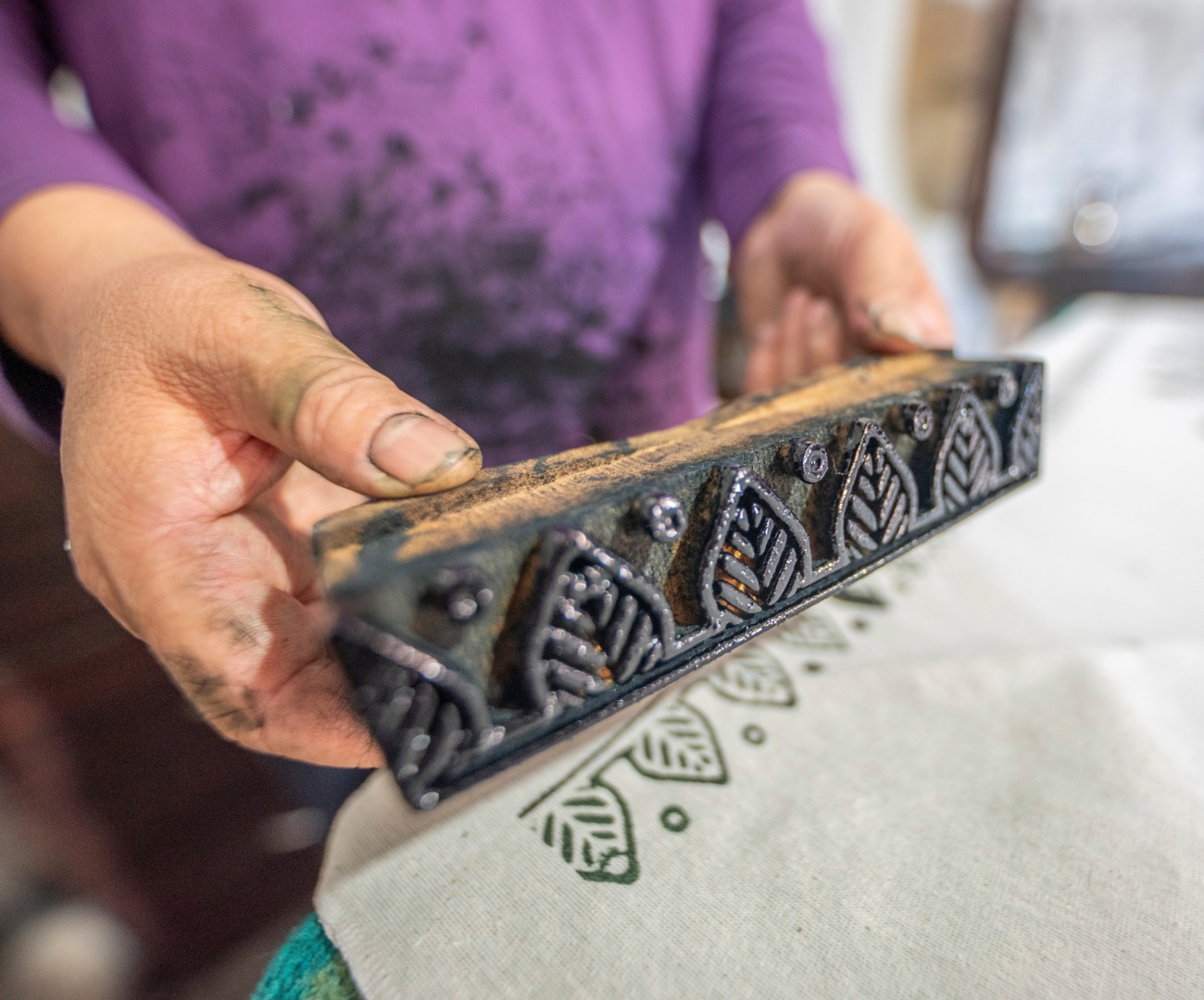
General Use: “The artisan used Block Printing to quickly reproduce the intricate floral pattern onto dozens of cotton scarves. Consequently, this allowed for the efficient, repetitive application of the design.”

Japanese Ukiyo-e – This genre of art, meaning “pictures of the floating world,” is the most monumental application of multi-color wood Block Printing. Artists like Hokusai created complex, layered images using dozens of different color blocks.

The Relief Principle – The hidden principle of Block Printing is that the artist carves away the negative space. Therefore, only the untouched, raised lines hold the ink, making it a relief printing method distinct from intaglio (incised) techniques.

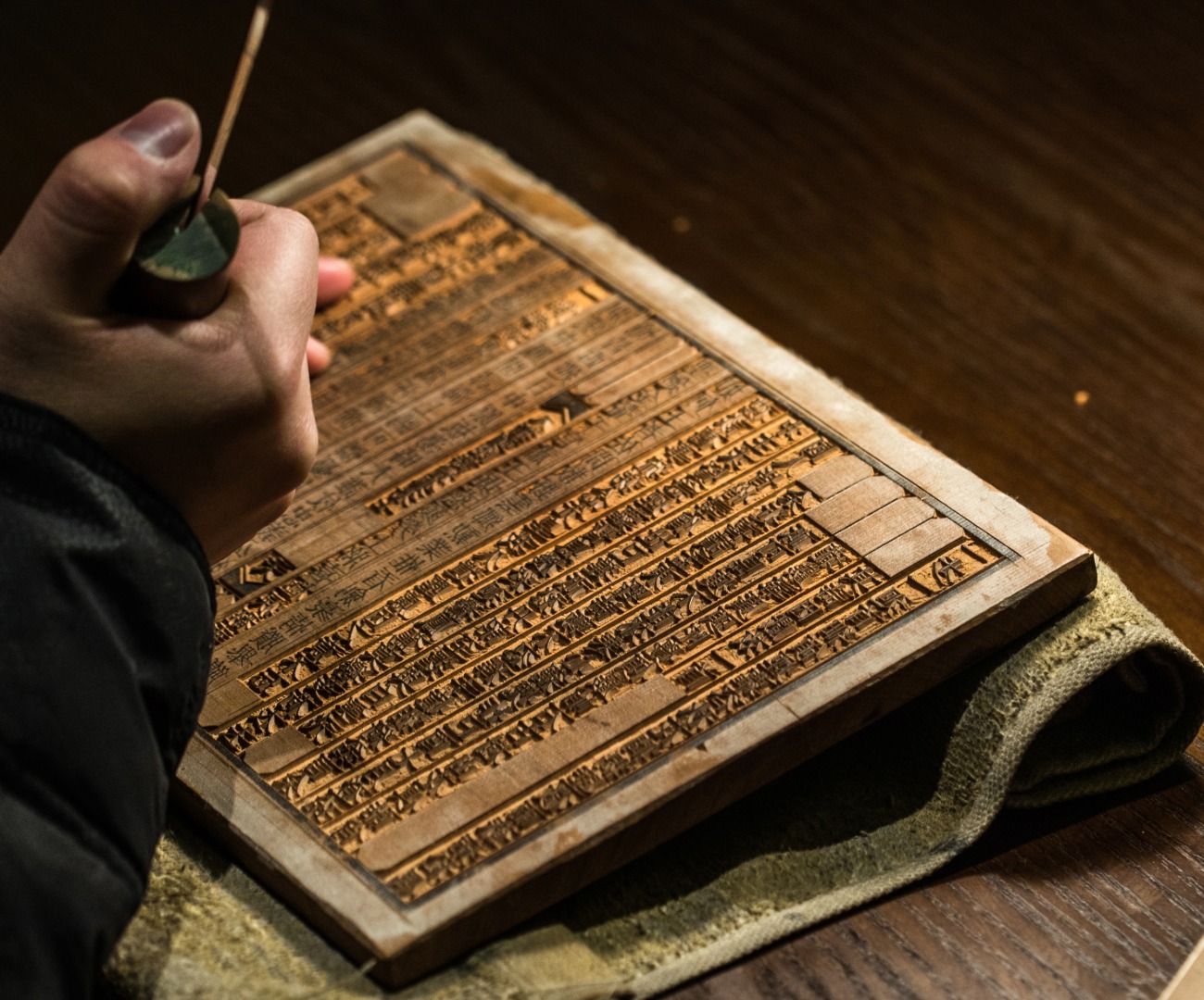
Chinese Origin – The earliest definitive evidence of Block Printing for text reproduction comes from China in the 7th century CE. This predates Gutenberg’s movable type press by hundreds of years, making its history monumentally ancient.
Did you know?
The earliest purpose of Block Printing was often religious. Whole pages of text and small illustrations for Buddhist sutras were printed using this method, making mass distribution of religious texts possible for the first time. Therefore, the ability to quickly and accurately reproduce images and text was a monumental development in the history of communication.
Block Printing Definition (Primary Context)
Block Printing is classified as a relief printing process. The process involves three main stages: first, the preparation of the block, where the design is drawn onto a flattened wood or linoleum surface and the negative spaces are carefully carved away; second, the inking of the raised surface with a roller (brayer) or brush; and third, the transfer, where pressure is applied to the back of the paper or fabric that has been laid over the inked block. The resulting image is a mirror reversal of the design carved into the block.

English: Compound of block (a solid piece of wood or metal) and printing (to impress or stamp), describing the tool and the action.

Woodblock Printing, Relief Printing, Xylography, Textile Printing (specific context).

Intaglio (printing from incised lines), Lithography (printing from a flat stone surface), Serigraphy (screen printing).

Printing Method, Reproduction, Graphic Art, Craft.
Historical Context of Block Printing
The earliest known application of Block Printing for texts dates to China’s Tang Dynasty, around 600 CE. By the Song Dynasty (960–1279 CE), it was a highly developed industry used to produce books, currency, and art. The technology spread west to Islamic cultures and east to Korea and Japan, where it led to the vibrant ukiyo-e art of the Edo Period. In Europe, Block Printing arrived in the 14th century. This development paved the way for Johannes Gutenberg’s invention of the printing press with movable type a century later.
Social Context of Block Printing
The invention of Block Printing radically democratized access to information and imagery. Prior to this technology, every copy of a book had to be handwritten, making it expensive and scarce. The speed and relative low cost of Block Printing allowed for the mass production of religious texts, government decrees, and popular literature. Therefore, it was a critical factor in raising literacy rates and disseminating knowledge across vast empires.
| Area of Influence | Significance and Impact |
| Literacy | The mass production of affordable books and pamphlets allowed a wider segment of the population to learn to read. |
| Religious Spread | The ability to quickly reproduce sutras and religious images greatly aided the spread of Buddhism and other religious doctrines. |
| Textile Industry | It enabled the mass production of complex, repeatable patterns on cloth. This lowered the cost of decorative fabric. |
| Cartography | Block Printings was used to reproduce the earliest, accurate maps. This supported navigation and military strategy. |
Terms Related to Block Printing
The process of Block Printing shares terminology with other printing methods and involves specific tools. Understanding these related terms provides essential context for graphic arts. This provides a clearer view of the technical framework surrounding printmaking.
| Term/Concept | Description and Relevance |
| Relief Printing | The general category of printing. The block is printed from the raised surface, not the recessed area. |
| Brayer | A roller used to apply a thin, even layer of ink to the raised surface of the block. |
| Key Block | In multi-color printing, this is the main block. It carries the primary lines and structural elements of the image. |
| Registration | The careful alignment of multiple carved blocks. This ensures that different colors line up precisely on the final print. |
| Ukiyo-e | The Japanese art form specializing in multi-color wood block prints. This is highly artistic. |
| Negative Space | The area carved away from the block. This part receives no ink and appears as the color of the paper or fabric. |
Sources & Credits
Sources
- Carter, T. F. “The Invention of Printing in China and Its Spread Westward.” Ronald Press, 1955. [Historical source]
- Griffiths, A. “Prints and Printmaking: An Introduction to the History and Techniques.” British Museum Press, 1996. [Historical source]
- “Woodblock Printing.” The Metropolitan Museum of Art: Heilbrunn Timeline. [Museum site]
- Tsien, T. H. “Paper and Printing.” Cambridge University Press, 1985. [Historical source]
- Meggs, P. B., and A. W. Purvis. “Meggs’ History of Graphic Design.” Wiley, 2011. [Historical source]