“Dagger”
Part of Speech: Noun
Quick Definition: A short knife with a pointed blade and two sharp edges, designed primarily for thrusting or piercing in close combat.
General Use: The soldier secured the iron dagger to his leather belt before entering the crowded narrow streets. Consequently, the choice provided excellent evidence of early weapon carrying habits and provided a clear record of personal defense tactics.
Overview
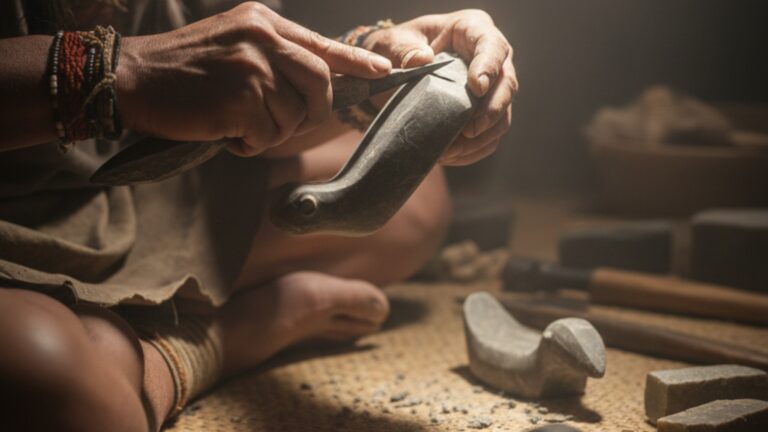
Military historians tightly link the physical and tactical development of ancient combat to the concept of the dagger. Originally, early tribal toolmakers established this double-edged blade technique as a pragmatic solution for close-quarters safety, but this habit eventually evolved into the foundational symbolic motif for status display across global civilizations. During the classical period, these specialized personal weapons provided a structured framework where smiths minimized weapon weight while maximizing piercing power, regulating the metal standards for elite gear across diverse regions.
Similarly, the transition into the iron age transformed the physical footprint of these short blades from simple utility tools into a highly active locus of political assassination, which shifted palace protection strategies from wide open battlefield guards to an elite network of hidden personal defenses. Furthermore, the rising technological movements of early states eventually adopted these precise forging methods to handle harder steels, thereby reflecting a complete technical evolution from a rudimentary chipped flint point to a global standard of military identity.

The production of a ceremonial hilt projected absolute leadership stability. Therefore, smiths used premium materials like gold wire to enhance the grip of these small weapons. Consequently, artisans decorated the matching sheaths to turn a simple utility tool into a grand gallery that showed off royal family success.

The public carry of status weapons often relied on political control hidden beneath everyday outfits. While leaders claimed to wear small blades purely for personal safety, they heavily masked the economic control of elite weapon shops behind thin layers of civic laws. As a result, the fine metal blades reinforced the power of the ruling families.
Ancient forge spaces were meticulously engineered for clear temperature control long before modern thermometers. For example, smiths optimized the size of the bellows air holes to break up slow burning spots and prevent metal flaws. Meanwhile, the smooth heat helped every single blade maker hammer the double edges perfectly to create a straight center ridge.
Quick Facts
| First Evidence | Neolithic Era (early examples made from chipped flint and bone shards) |
| Common Features | Double sharp edges, Pointed tip, Central blade ridge, Guard fittings |
| Precious Materials | Smelted bronze, Quenched iron, Ivory grips, Gold sheet wrap |
| Primary Function | Close military combat, Secondary personal defense, Sacred ritual sacrifice |
| Archeological Term | Double-Edged Thrusting Blade |
| Cultural Variance | Moves from early tribal copper pins to imperial iron short swords |
| Symbolic Role | Showing personal courage, Elite rank, and Secret political power |
| Economic Impact | High-cost charcoal fuel trade and specialized metal forging guilds |
| Key Discovery | King Tutankhamun iron meteoric blade, Bronze Age European hoard sites |
| Afterlife Concept | The conceptual transition into a protective tool buried next to the warrior |
| Preservation | Achieved through removing rust scale and applying thick wax seal layers |
| Modern Practice | Retained as the core historical baseline for tactical close combat gear |

Primary Context of Dagger
A pointed blade reflects the defensive priorities of its era, revealing exactly what a society deemed most essential for personal combat and metalwork control. Planners and masters prepared these weapons by selecting high-grade copper or iron blocks, which wealthy tribal lords or state army treasuries frequently supported through direct trade payments. Smiths subsequently arranged the physical features in a highly planned layout, placing the heavy pommel weight at the base while the sharp point sat at the absolute tip. Moreover, the physical orientation of these edges always ran down both sides, anchoring the combat use of the object to dual slicing motions that soldiers considered fast and efficient.

Etymology: From the Old French dague, meaning a short pointed dagger, which likely came from early European root words for piercing or stabbing tools.

Synonyms: Dirk weapon, Thrusting blade, Stiletto knife, Short poniard, Combat blade.

Antonyms: Long battle spear (hasta), Heavy cutting axe (securis), Curved cavalry sword (gladius).

Thesaurus: Knife, Blade, Weapon, Dirk, Stiletto.
The deep royal graves, muddy ancient battle zones, and urban workshop streets of the old world serve as the primary locus of activity for the archaeological recovery of these blade remnants. Beyond their tactical value, modern researchers utilize these objects to map the spread of early metal mixing ideas and global casting styles across Europe and Mediterranean regions. Today, conservation teams continuously maintain these fragile metal finds through chemical cleaning projects to prevent the degradation of old iron sheets and delicate handle decorations. Furthermore, the digital charting of these weapon finds remains a collaborative task for the global archaeological community seeking to visualize ancient military zones.
Social Context of Dagger
The choice to forge compact short blades shows how early communities learned to handle local mining limits and save their cultural heritage. By studying old blade shapes, researchers can see how smiths changed their methods to survive brittle tin mixes, hot fuel shortages, or poor mineral ore conditions over hundreds of years. For example, groups in copper-poor regions used thin leaf patterns to keep blades strong, while workshops in hot dry zones added thick leather wraps to avoid sweat slip during summer drill practice. Therefore, these choices helped protect vital army assets and personal defense gear from natural ruin. Consequently, this metalwork became a key tool for survival, and it showed how human groups adapted to their local metal pools while keeping their local identity strong.

The decoration of a fine hilt provides a stark visual record of the wealth differences and civic values present in ancient city communities. By comparing a simple wood-handled work knife to the monumental gold blades found in palace rooms, researchers can measure the social hierarchy of a specific era with remarkable precision. Within the fabric of early palace life, the lavish display of these status markers served to validate local kings’ right to rule by demonstrating their financial control over elite smithing workshops. Furthermore, the mass creation of these weapons provided steady employment for specialized guilds of iron beaters, leather workers, and gem setters. Maintaining the sharpness of these shared tools was a civic duty enforced by regular guard checks and the fear of sudden attack, ensuring that group authority remained intact through generational transitions.
Did you know? Dagger
The typical ancient armor master viewed a combat dagger not merely as a small emergency backup knife, but as a critical tactical tool that required precise balance planning before any metal pouring could start. Because the thin blade could only properly slice through leather shields if the metal weight was balanced evenly against the handle grip, every workshop task was preceded by an analysis of metal purity to ensure structural safety.
Furthermore, the survival of these steel edges today is entirely due to this careful planning, which combined tough local ores with smart water cooling tricks to resist battlefield stress. Therefore, the ancient weapon record was preserved as a self-contained craft ecosystem that allowed these complex military traditions to survive intact until modern makers copied them for formal dress gear.
Terms Related to Dagger
| Quillon | The crossguard bar that stops an enemy blade from sliding onto the fingers. |
| Pommel | The heavy metal knob at the end of the grip used to balance the blade weight. |
| Tang | The hidden back part of the steel blade that slides into the wood handle. |
| Scabbard | The protective pocket sheath used to carry the sharp blade safely on a belt. |
| Hilt | The total collection of parts making up the weapon handle and hand guard area. |
| Fuller | A long middle groove pressed into the blade face to lower overall weight. |
| Ricasso | The unsharpened section of blade right above the hand guard frame. |
| Acinaces | A specific ancient Persian short dagger worn as a royal status marker. |
| Pugio | The standard iron dagger carried by Roman legion soldiers on their left side. |
| Stiletto | A late Italian dagger style with a very thin blade made just for piercing armor. |
| Smelting | The intense furnace task of separating pure copper or iron from raw rocks. |
| Quenching | Dipping hot glowing steel into oil or water to lock in metal hardness. |
| Inlay | Pressing silver or gold wire into cut patterns on the dark steel surface. |
| Chape | The metal protective button found at the absolute bottom tip of a sheath. |
| Parrying | Using the short guard bar to deflect an incoming strike away from the chest. |
| Meteoric | Rare early iron sourced from fallen sky rocks long before deep underground mining. |
| Carburization | Heating iron alongside charcoal dust to add carbon strength to blade edges. |
| Damascene | An ancient style of folding different metal bars to create wavy blade patterns. |
| Balearic | Island fighters famous for carrying distinct bronze short knives into battle. |
| Flint | A hard stone option chipped down by early humans to make sharp pre-metal points. |
Sources & Credits
Sources
- Blades and Swords: A Visual History of Weapons – Edge, D. Dorling Kindersley, 2006. [Visual and weapon history source]
- The Archeology of Weapons: Arms and Armour from Prehistory to the Age of Chivalry – Oakeshott, E. Lutterworth Press, 1960. [Administrative and combat archive]
- Ancient Persian Metalwork – Moorey, P. R. S. Oxford University Press, 1971. [Metallurgical and context source]
- Journal of Archaeological Science – Trace Element Analysis of Bronze Age Stabbing Blades. [Scientific and metal preservation source]
- The Iron Age Weapon Hoards – Evans, J. Public Domain / Longmans Green. [Primary excavation data source]