Table of Contents: Definition – Hoplite
“Hoplite “
Term: Hoplite
Pronunciation: /ˈhɒplaɪt/ (HOP-lyte)
Part of Speech: Noun
Hoplite Definition (Greek Context):
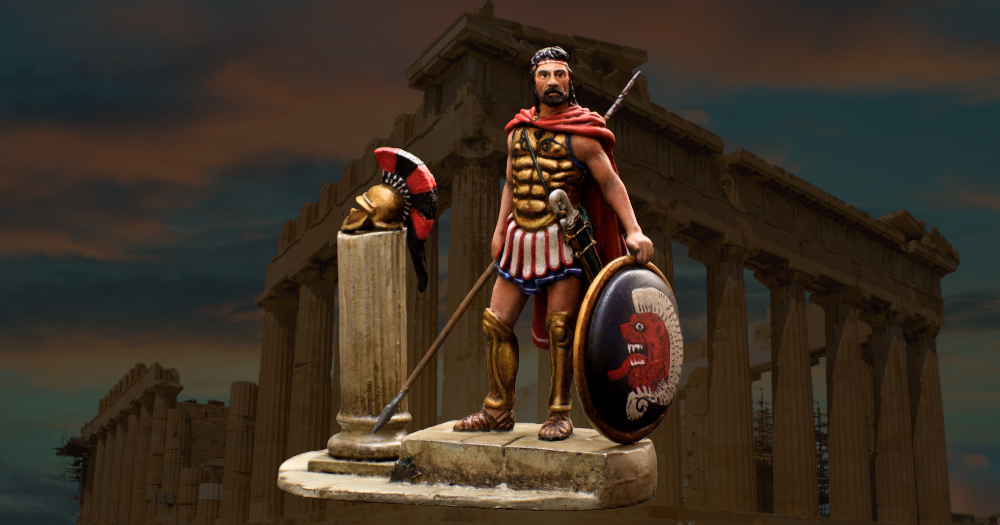
A hoplite was a heavily armed foot soldier of ancient Greece. Emerging around the 7th century BCE, these warriors were typically free citizens – landowners or artisans – who could afford their own panoply (full armor and weapons). Their primary weapon was a long spear, and their most distinctive piece of equipment was the aspis, a large, round shield. They fought in a close-order, shoulder-to-shoulder formation known as the phalanx, emphasizing discipline and collective strength.
Origin of the Word “Hoplite”:
The term “hoplite” (ὁπλίτης / hoplitēs) comes from the Greek word hoplon (ὅπλον), which referred to their equipment, particularly the large shield.
Examples:
General Use: “The hoplites advanced in a unified phalanx against the enemy.”
Archaeological Context: “Excavations have revealed numerous bronze helmets and shield fragments belonging to hoplites.”
Historical Context: “Hoplite armies were crucial in the defense of Greek city-states during the Archaic and Classical periods.”
Military Context: “The effectiveness of the hoplite phalanx relied on the cohesion and discipline of the individual soldiers.”
Vocabulary and Language Resources
Terms Related to Hoplites
- Phalanx: The close-order, rectangular formation in which hoplites fought, with shields overlapping for mutual protection.
- Panoply: The complete set of armor and weapons worn by the Greek soldier, including helmet, breastplate, shield (aspis), greaves, spear (dory), and sword (xiphos).
- Aspis: The large, round, bronze-faced shield that was the hoplite’s most important defensive weapon.
- Dory: The long (typically 7-9 feet), thrusting spear used as the soldiers’ primary offensive weapon.
- Xiphos: A short, double-edged sword used as a secondary weapon for close combat.
- Greaves: Bronze or leather armor worn to protect the lower legs.
- Cuirass: Body armor, initially bronze (bell or muscle cuirass) and later often linen (linothorax).
Etymology
From ancient Greek ὁπλίτης (hoplítēs), meaning “heavily armed foot-soldier,” derived from ὅπλον (hóplon), referring to their arms, especially the shield.
Synonyms
Heavy infantryman (ancient Greek).
Antonyms:
Light infantryman (e.g., psiloi who were skirmishers), cavalryman (hippeus).
Thesaurus
Soldier, infantryman, warrior, combatant, foot soldier, guardsman (in a civic context).

Hoplite Historical & Cultural Context:
The rise of the hoplite and the phalanx formation was a significant development in ancient Greek warfare, linked to the growth of the polis (city-state). The equipment was expensive, signifying a degree of citizen participation in defense. Battles between hoplite armies often consisted of a direct clash of phalanxes. While effective on level terrain, the phalanx was vulnerable to flanking maneuvers or broken ground. The ethos emphasized courage, discipline, and loyalty to one’s comrades, as the formation’s strength depended on each soldier holding their position. The warriors image became central to Greek identity and is famously embodied by the Spartans.
Principles or Key Aspects of the Hoplite:
- Heavy Armor: Equipped with substantial defensive weaponry.
- Phalanx Warfare: Fought in a close-knit, disciplined formation.
- Citizen-Soldiers: Typically free citizens who provided their own equipment.
- Spear and Shield: Primary weapons were the thrusting spear and large round shield.
- Collective Strength: Emphasized unity and mutual protection within the phalanx.
Ethical Considerations for Hoplite:
- Representation of Warfare: Acknowledging the brutal realities of ancient combat.
- Interpretation of Courage: Understanding the societal values placed on military prowess.
Relevance to Ancient Worlds
Hoplites are crucial for understanding ancient Greece because they:
- Shaped Military History: Their tactics and equipment influenced warfare for centuries.
- Reflected Social Structures: Their citizen status highlights the link between civic duty and defense.
- Embodied Cultural Values: Their courage and discipline were idealized in Greek society.
- Influenced Political Development: The rise of the hoplite class is sometimes linked to broader political changes in the poleis.
Art2Fact Society Nuance
For the Art2Fact Society, the hoplite represents a fascinating study in the intersection of military technology, social organization, and cultural values in ancient Greece. The design and evolution of their panoply, the effectiveness of the phalanx formation, and the citizen-soldier ethos offer rich areas for exploration and contemporary interpretation within the “ancient revival project.” The Greek soldier stands as an iconic symbol of ancient Greek civilization, embodying both its military might and its commitment to civic participation.