Table of Contents: Definition – Hydria
“Hydria “
Term: Hydria (plural: Hydriai)
Pronunciation: /ˈhɪdriə/ (HID-ree-uh)
Part of Speech: Noun
Hydria Definition (Greek Context):
A hydria was a type of ancient Greek pottery vessel primarily used for carrying water. Characterized by its distinctive three handles – two horizontal handles on the sides for lifting and a vertical handle at the back for pouring – the hydria was a common and practical container from the late Geometric period (7th century BCE) through the Hellenistic period (3rd century BCE). While its main function was water transport, hydriai also served other purposes, such as holding oil, acting as ballot boxes, containing ashes as funerary urns (especially the Hadra hydria type), and even being awarded as prizes.
Origin of the Word “Hydria”:
The term “hydria” (ὑδρία) comes directly from the ancient Greek word “hydor” (ὕδωρ), meaning “water,” clearly indicating the vessel’s primary use.
Examples:
General Use: “Women would often carry a hydria to the public fountain to collect water.”
Archaeological Context: “Excavations have unearthed numerous hydriai, decorated in both black-figure and red-figure styles.”
Art History Context: “The decoration on hydriai often depicts scenes related to water, mythology, or daily life.”
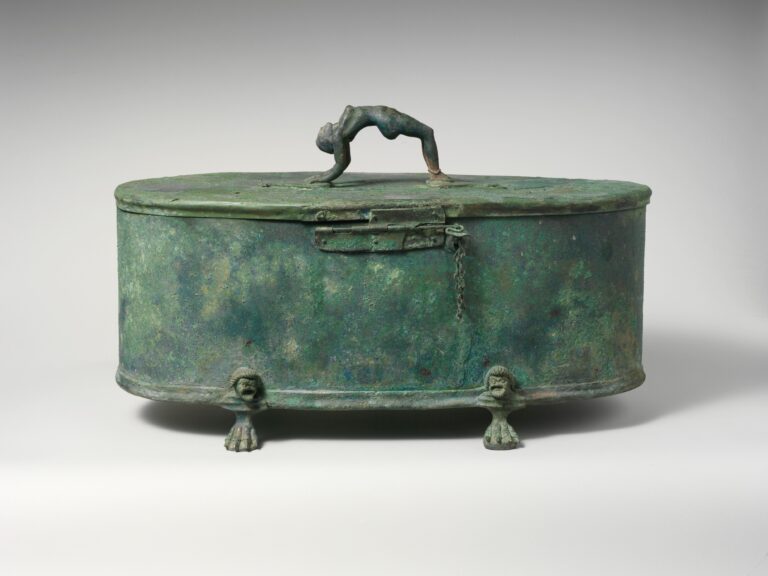
Funerary Context: “Some elaborately decorated bronze hydriai were used as cinerary urns for important individuals.”
Art2Fact Context: “The elegant shape and practical design of the hydria can inspire contemporary designers focused on sustainable and functional containers.”
Vocabulary and Language Resources
Related Terms
- Kalpis: A later, round-shouldered variant of the hydria with a continuous curve from lip to body.
- Hydriske/Hydriskos: A small hydria.
- Amphora: A two-handled storage jar.
- Oinochoe: A wine jug used for pouring.
Etymology
From ancient Greek ὕδωρ (hýdōr), meaning “water,” the primary substance this vessel carried.
Synonyms
Water jar: A common English term for its main function.
Water pot: Another simple term for a container of water.
Pitcher: Highlights the pouring aspect facilitated by its handle.
Antonyms:
Storage jar: Vessels like amphorae or pithoi, designed for longer-term storage.
Drinking cup: Vessels like kylikes, used for consuming liquids.
Thesaurus
Container: A general term for a holding object.
Vessel: A more formal term for a receptacle.
Jug: A container with a handle and spout for pouring.
Pot: A round container often used for liquids.
Carrier: Emphasizes its transport function.
Receptacle: A formal term for something that holds.

Hydria Historical & Cultural Context:
The hydria evolved in shape over time. Early forms in the Archaic period (7th-6th centuries BCE) typically had a wider body and more angular shoulders. By the 5th century BCE, the kalpis form, with its continuous curve, became popular, particularly among red-figure painters. Hydriai were crafted from both terracotta and bronze, with bronze examples often being more ornate and valuable, sometimes featuring cast handles in the form of human or animal figures. These metal hydriai were sometimes used as grave goods or dedicated as offerings in sanctuaries. The decoration on terracotta hydriai provides rich insights into ancient Greek culture, depicting mythological narratives, religious rituals, scenes of daily life (like women at the fountain – the hydrophoria), and athletic contests. The Meidias Hydria in the British Museum is a particularly famous and elaborate example of a red-figure hydria.
Principles or Key Aspects of Hydria:
- Three Handles: Two horizontal for lifting, one vertical for pouring.
- Water Carrier: Primary function was to transport water.
- Varied Forms: Evolved in shape from round-bodied to the kalpis.
- Diverse Decoration: Adorned with scenes in black-figure and red-figure techniques.
- Multiple Uses: Also served as containers for oil, ballot boxes, funerary urns, and prizes.
Ethical Considerations for Hydria:
- Provenance: Ensuring the ethical sourcing of archaeological hydriai.
- Conservation: Preserving the often fragile ceramic and metal examples.
- Interpretation: Understanding the various functions and symbolic meanings of hydriai in their original contexts.
Relevance to Ancient Worlds
The hydria is important for understanding ancient Greece because it reveals:
- Practical Aspects of Daily Life: The importance of public fountains and water carrying.
- Artistic Development: Showcases the evolution of pottery shapes and decorative styles.
- Social Customs: Depictions offer glimpses into daily activities and rituals.
- Funerary Practices: The use of hydriai as cinerary urns.
- Material Culture: Highlights the skilled craftsmanship in both pottery and metalworking.
Art2Fact Society Nuance
For the Art2Fact Society, the hydria embodies the intersection of practical necessity and artistic expression in ancient Greece. Its functional design, adapted over time for efficiency, was also a canvas for intricate decoration that reflected cultural values and beliefs. Studying the hydria can inspire contemporary artists and designers to consider how everyday objects can be both useful and beautiful, bridging the gap between form and function in ways that resonate with the ancient Greek appreciation for both.