Table of Contents: Definition – Red-figure Pottery
“Red-figure Pottery “
Term: Red-figure pottery (Greek)
Pronunciation: /ˈrɛd ˈfɪɡjər ˈpɒtəri/ (RED FIG-yer POT-uh-ree)
Part of Speech: Noun
Red-figure Pottery Definition (Greek Context):
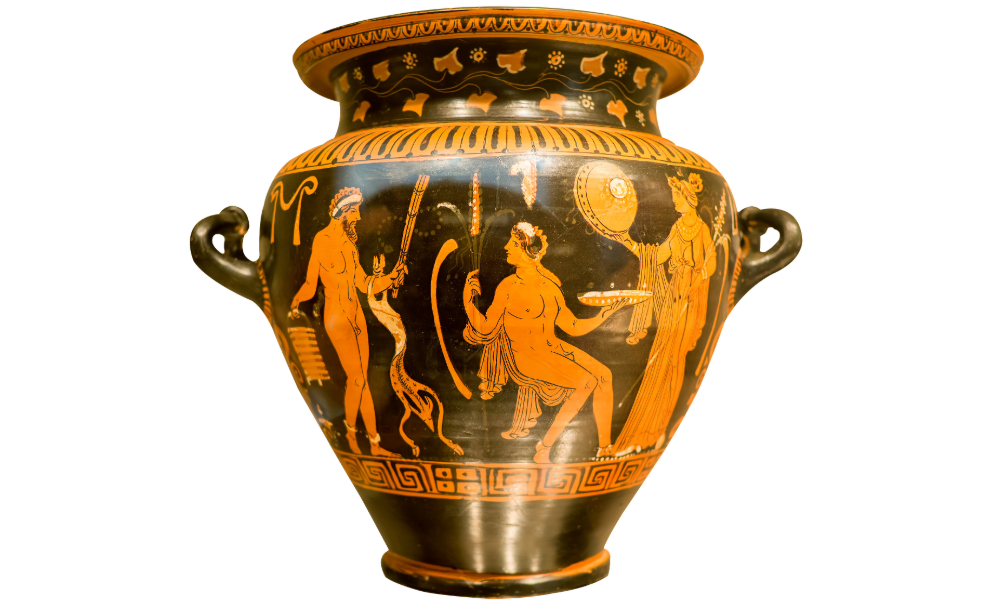
Red-figure pottery is a style of ancient Greek pottery that emerged in Athens around 530 BCE and became the dominant style by the early 5th century BCE. It is characterized by red or orange figures and details standing out against a black-painted background. This was achieved by painting the background with a black slip while leaving the figures in the natural color of the fired clay. Details within the red figures were then added using a brush with black slip, sometimes diluted to create brown or golden tones, or with added colors like white or red. This technique was essentially the reverse of the earlier black-figure style.
Origin of the Term “Red-figure Pottery”:
The modern term “red-figure pottery” directly describes the visual characteristic of this style: red figures on a black background. The ancient Greeks referred to it as erythrómorpha (ἐρυθρόμορφα), which also translates to “red-figured.”
Examples:
General Use: “Red-figure pottery allowed Greek artists greater freedom in depicting human anatomy and movement.”
Archaeological Context: “Fragments of red-figure kraters and kylikes are common finds in Athenian excavations.”
Art History Context: “The red-figure style represents a significant advancement in Greek ceramic art, leading to more naturalistic and detailed representations.”
Mythological Context: “Many red-figure vases depict scenes from Greek mythology and heroic legends.”
Daily Life Context: “Some red-figure pieces illustrate aspects of Athenian daily life, such as symposia or athletic contests.”
Vocabulary and Language Resources
Related Terms
- Black-figure pottery: The preceding style with black figures on a red background.
- Slip: A mixture of fine clay and water used as paint.
- Kylix: A shallow drinking cup, often decorated in the red-figure style.
- Krater: A large mixing bowl for wine and water, frequently adorned with red-figure scenes.
- Lekythos: A slender oil flask, sometimes featuring white-ground and red-figure techniques.
- Attic pottery: Pottery produced in the Attica region of Greece, where the red-figure style originated and flourished.
Etymology
“Red-figure” describes the visual style. Greek erythrómorpha (ἐρυθρός – “red” + μορφή – “form, shape”).
Synonyms
Erythrómorpha (ancient Greek).
Antonyms
Black-figure pottery.
Thesaurus
Not typically used as a common English word requiring extensive thesaurus entries, but related concepts include: Greek vase painting, ceramic art.

Red-figure Pottery Historical & Cultural Context:
Originating in Athens around 530 BCE, the red-figure technique, often credited to the Andokides Painter, surpassed black-figure by enabling finer brushed details over laborious incisions. This fostered more realistic portrayals of anatomy, drapery, and emotion, alongside varied perspectives. Initially coexisting with “bilingual” vases, red-figure swiftly became Athens’ dominant style by the early 5th century BCE. While Athens remained the main producer, the style extended to regions like Magna Graecia. Red-figure vases depicted myths, heroic stories, athletics, rituals, and Athenian daily life, offering crucial insights into ancient Greek culture, society, and beliefs. High-quality production waned near the late 4th century BCE. Sources and related content
Principles or Key Aspects of the Word Black-figure Pottery.:
- Reverse Technique: Red figures on a black background.
- Brushwork Detail: Allowed for finer and more detailed internal lines and features.
- Greater Realism: Facilitated more naturalistic depictions of the human form.
- Perspective: Enabled the portrayal of figures in various poses and perspectives.
- Narrative Focus: Often depicted mythological stories and scenes from daily life.
Ethical Considerations for Black-figure Pottery.
- Provenance: Crucial for understanding the context and legitimacy of red-figure pottery.
- Conservation: Proper care is needed to preserve the painted surfaces.
- Interpretation: Understanding the cultural and artistic significance of the depicted scenes.
Relevance to Ancient Worlds
Red-figure pottery is vital for understanding ancient Greece because it:
- Reflects Artistic Innovation: Demonstrates a significant advancement in ceramic painting techniques.
- Provides Visual Narratives: Illustrates myths, legends, and aspects of daily life.
- Offers Insights into Culture: Reveals details about religious beliefs, social customs, and athletic practices.
- Aids in Chronology: Stylistic developments help archaeologists date sites and artifacts.
- Shows Trade Connections: Its presence outside of Athens indicates trade networks.
Art2Fact Society Nuance
For the Art2Fact Society, red-figure pottery exemplifies the sophisticated artistry and narrative power of ancient Greek material culture. The detailed figures and dynamic compositions found on these vessels offer a rich source of inspiration for contemporary artists and designers interested in visual storytelling and the human form. Studying the techniques and iconography of red-figure pottery can inform modern creative explorations within the “ancient revival project,” fostering a connection to the expressive capabilities of line, form, and narrative as practiced by ancient Greek artisans.