“Belt Hook
Pronunciation: /bɛlt hʊk/ (BELT hook)
Part of Speech: Noun
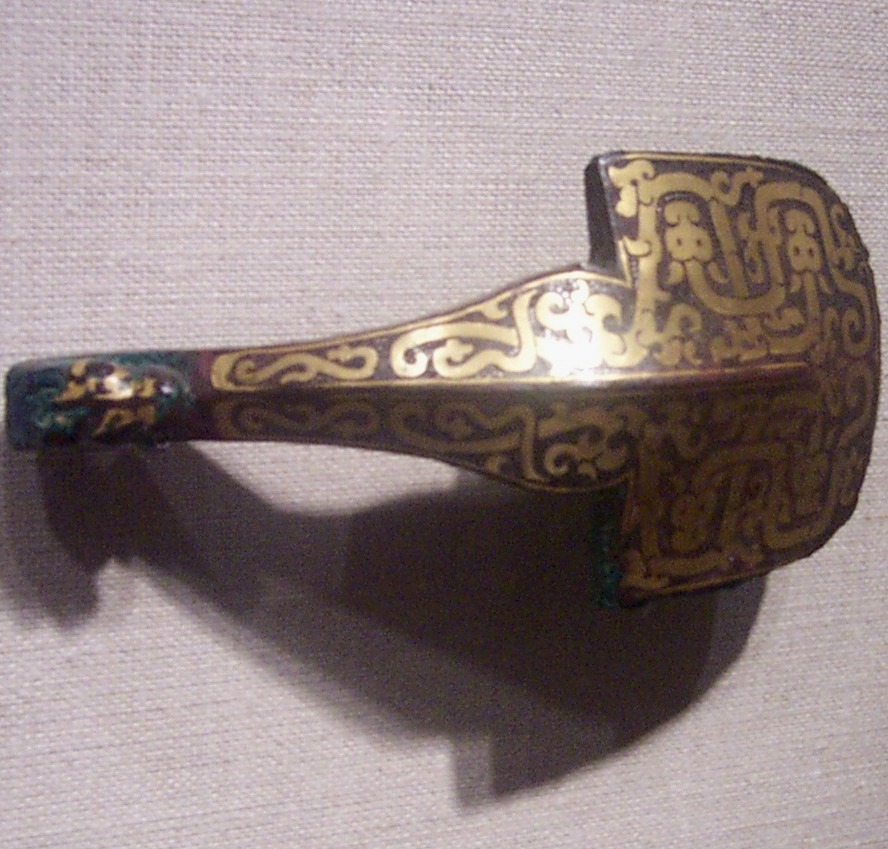
Quick Definition: A decorative and functional metal fastener (often called a daigou in Chinese contexts) consisting of a hook, a curved body, and a stud, used to secure waist belts in antiquity.
General Use: “The burial chamber of the Marquis contained a masterfully crafted Belt Hook. Consequently, the monumental small find provided excellent evidence of personal wealth and provided a clear indicator of the owner’s high social standing.”

Micro-Sculpture – The monumental artistry of the Belt Hook lies in its density of detail. Artisans utilized techniques such as gold and silver inlay (damascene), turquoise encrustation, and openwork casting to transform a simple fastener into a unique piece of organic, functional sculpture that often depicted dragons, tigers, or intertwining serpents.

The Stud Mechanism – The hidden technical truth about the Belt Hook is the importance of the rear stud. While the hook was the most visible part, the underside stud was the structural anchor that fitted into a hole in the leather belt; thus, the security of the entire garment depended on the monumental precision of this small, hidden component.
A Marker of Luxury – The monumental cultural value of these objects peaked during the Warring States period and the Han Dynasty. Archaeological surveys indicate that the most elaborate Belt Hook examples were reserved for the highest nobility, representing a monumental shift in ancient fashion where accessories became primary political symbols.
Did you know?
The typical ancient aristocrat viewed the Belt Hook as a self-contained statement of lineage and taste. These objects were often buried with the owner to maintain their appearance in the afterlife, providing a monumental integration of daily attire and funerary ritual that allows modern scholars to track the evolution of ancient garment technology.
Belt Hook Definition (Primary Context)
The monumental Belt Hook construction is built almost entirely of bronze or precious metals, often enhanced with semi-precious stones. It typically consists of a curved shank, a hook at one end usually shaped like a bird or dragon head, and a circular stud on the reverse side for attachment. The structure is often solid and cast using the lost-wax method, leading to a durable accessory that resists the daily tension of a cinched waist.
Access to the visual surface was managed through elaborate gilding or inlay fashioned into the metal while it was still warm or after it had cooled. The foundry floor was the primary locus of technical activity, where the delicate balance of metals was achieved. The entire object is continuously maintained in museum archives today, with the surfaces requiring careful environmental control to prevent “bronze disease,” making the conservation a communal and monumental task.

Belt: From Old English belt, a strip of leather. Hook: From Old English hoc, a curved piece of metal. Daigou: The specific Chinese term meaning “carrying hook.”

Daigou, Fibula (Western equivalent), Belt Buckle, Garment Fastener.

Button (a different fastening method), Pin (piercing rather than hooking), Knot (securing via tying).

Adornment, Regalia, Hardware, Metallurgy.
Historical Context of Belt Hook
The development of the monumental Belt Hook is historically linked to the introduction of nomadic riding attire to the sedentary cultures of China around the 5th century BCE. The need for security during horseback riding drove the evolution of the fastener from simple ties to the monumental, metal hooks capable of withstanding the rigors of cavalry warfare. The architectural style of these hooks remained a staple of East Asian fashion for centuries, representing a monumental continuity of military and courtly tradition.

Social Context of Belt Hook
The Belt Hook process perfectly encapsulates the social structure of the ancient world. The distribution of these objects was often organized according to strict sumptuary laws and royal gift-giving. The belt itself served as a communal, monumental space linking the individual’s physical body to their rank in the imperial bureaucracy. Internal roles in the workshop were highly prescribed: the master goldsmith guarded the inlay secrets, and the finished hooks were treated with immense respect. Casting these pieces was a communal effort involving multiple specialized smiths, reinforcing social cohesion and passing monumental metallurgical knowledge down to the next generation.
| Area of Influence | Significance and Impact |
| Military Reform | The transition to Belt Hook fasteners allowed for the adoption of trousers and cavalry, providing monumental security for the borders. |
| Artistic Exchange | The use of animal motifs from the Steppe provided monumental evidence of cultural interaction between nomads and empires. |
| Status Indicator | Specific materials like jade or gold were dedicated to royal use. This makes the hook a monumental political center. |
| Technological Growth | The demand for high-quality fasteners ensured the state’s ability to refine complex gilding and inlay techniques. |
Terms Related to Belt Hook
The study of the Belt Hook involves specialized terminology related to its form and decoration. This provides essential context for Asian and Eurasian archaeology. This provides a clearer view of the technical framework surrounding the monumental fastener.
| Term/Concept | Description and Relevance |
| Daigou | The primary monumental Chinese term for the hook-and-stud fastener system. |
| Zoomorphic | The general term for animal-shaped designs, a hallmark of Belt Hook artistry. |
| Inlay | A specific decorative technique. This involves pressing gold or silver wire into the bronze body. |
| Lost-Wax | The monumental casting process. This allowed for the complex 3D shapes of the hook heads. |
| Stud | The circular anchor on the back. This is the part that secured the Belt Hook to the leather. |
| Openwork | A decorative style featuring gaps or holes. This was used for the most monumental and expensive examples. |
Sources & Credits
Sources
- So, J. F. and Bunker, E. C. “Traders and Raiders on China’s Northern Frontier.” Smithsonian Institution, 1995. [Historical source]
- Lawton, T. “Chinese Art of the Warring States Period: Selected Items from the Free Gallery of Art.” Smithsonian Institution, 1982. [Historical source]
- “Ancient Chinese Daigou: Functional Art.” National Museum of Asian Art, Smithsonian. [Museum site/definition site]
- Yang, B. “Contributions to the Study of Chinese Belt Hooks.” British Museum Occasional Papers. [Historical source]
- The Palace Museum, Beijing. “Research on Han Dynasty Bronze Small Finds.” [Government institutional body/definition site]
- By Vassil – Own work, Public Domain, https://commons.wikimedia.org/w/index.php?curid=2990309
- By User:PericlesofAthens – Freer and Sackler Galleries, Washington D.C., Public Domain, https://commons.wikimedia.org/w/index.php?curid=5733941