Proto-Tibetan Tribes, Lhapa/Drukpa Schools, Zhabdrung Era, Wangchuck Dynasty.

Ngalop, Sharchop, Lhotshampa, Himalayan-Buddhist.

Eastern Himalayas, Deep Gorges, Subtropical Jungles, Gangkhar Puensum (unclimbed).
Thimphu (Capital), Paro, Punakha, Phuntsholing, Wangdue Phodrang.

Thangka Paintings, Phurba (Ritual Daggers), Dzong architecture, Hand-loomed Textiles.

Dzongkha (Official), Sharchop, Lhotshampa, English.

Vajrayana Buddhism (State religion), Hinduism, Animism (Bon).

Zhabdrung Ngawang Namgyal, Jigme Singye Wangchuck, Jigme Khesar Namgyel Wangchuck.

Tiger’s Nest (Paro Taktsang), Punakha Dzong, Buddha Dordenma, Tashichho Dzong.
Overview: Bhutan
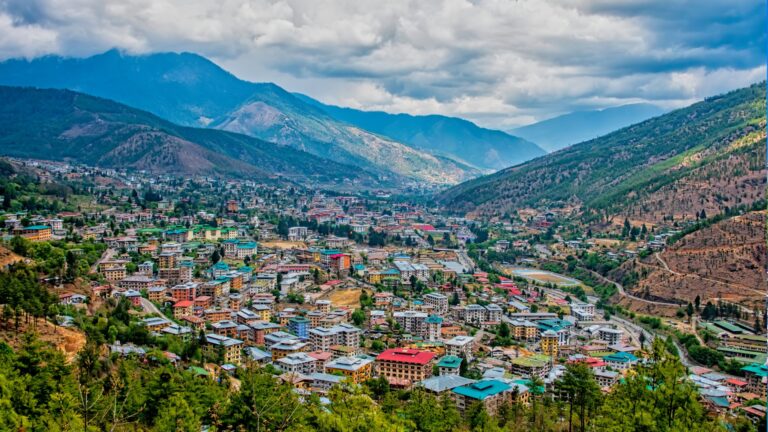
Tucked within the formidable heights of the Eastern Himalayas, the topography of Bhutan rises sharply from the southern subtropical plains to glacial peaks exceeding 7,000 meters. Consequently, the isolation provided by these vertical barriers allowed the nation to remain one of the few territories in Asia never colonized by a foreign power.
Historically, the deep, North-South oriented river valleys created distinct micro-climates and social enclaves, which the Dzong system eventually unified into a cohesive administrative network. Furthermore, the kingdom’s commitment to environmental preservation ensures that over 70% of the land remains forested, acting as a vital sanctuary for endangered species like the snow leopard and Bengal tiger.
ART: Thangka paintings represent the pinnacle of Bhutanese sacred art; these intricate scrolls, painted with mineral pigments and gold, serve as meditation tools that depict Buddhist deities, mandalas, and the lives of great lamas with mathematical precision.
HIDDEN TRUTH: Gangkhar Puensum, the highest point in Bhutan, is widely considered the highest unclimbed mountain in the world; the government banned mountaineering above 6,000 meters in 1994 to respect local spiritual beliefs that peaks are the homes of protective deities.

FACT: Bhutan is the only country in the world that is Carbon Negative, meaning its vast forests absorb significantly more carbon dioxide than the entire nation produces through human activity.
Rather than pursuing conventional industrial metrics, the identity of Bhutan evolved around the visionary philosophy of Gross National Happiness (GNH), which prioritizes spiritual and communal well-being over purely economic growth. Indeed, the 17th-century arrival of Zhabdrung Ngawang Namgyal fundamentally transformed the landscape by establishing a dual system of government that balanced secular law with religious authority.
Moreover, the transition from an absolute monarchy to a constitutional democracy in 2008 demonstrated a rare example of a sovereign voluntarily devolving power to ensure the stability of the state. As a result, the modern nation functions as a global leader in sustainability, famously maintaining a carbon-negative status while protecting its deep-rooted Vajrayana Buddhist traditions.
Cultural Heritage
The building traditions of the “Land of the Thunder Dragon” emphasize a harmonious relationship between human structures and the natural spirits of the land. From the massive rammed-earth walls of the Dzongs to the intricate wooden shingle roofs of village homes, architects utilized local timber, stone, and clay without the use of nails or formal blueprints. This legacy manifests in the Dzong, a unique fortress-monastery design that serves as the religious, military, and administrative center of each district, featuring inward-sloping walls and brightly painted cornices.

Environmental adaptation forced the development of ingenious heating and ventilation systems to manage the extreme Himalayan temperature swings. Builders oriented traditional houses to maximize sunlight and utilized thick walls to retain heat, while the iconic phallus paintings on exterior walls served as symbolic protection against evil spirits. This legacy continues in modern Thimphu, where strict building codes mandate that all new structures must incorporate traditional motifs and colors, ensuring the kingdom maintains its distinct visual identity in the face of modernization.
| Art and Architecture | Dzong Style, Rammed Earth, Zorig Chusum (13 Arts), Slate Carving. |
| Natural Resources | Hydropower (Main export), Timber, Gypsum, Dolomite, Medicinal Herbs. |
| Trade Routes | Ancient Himalayan Salt Routes, Modern Indo-Bhutan trade corridors. |
| Urban Engineering | Thimphu Urban Expansion, Hydropower Dam Construction, Vertical farming. |
| Agriculture & Flora | Red Rice, Buckwheat, Blue Poppy (National Flower), Rhododendrons. |
| Pottery & Ceramics | Traditional Hand-molded Pottery (Lhuentse), Ritual clay statues. |
| Metallurgy | Bronze Casting (Statues), Wrought Iron Bridge Building (Thangtong Gyalpo). |
| Glassmaking | Minimal local production, Imported modern architectural glass. |
| Military and Warfare | Duar War (1864-65), Battle of Five Lamas, Traditional Archery. |
| Textile Arts | Kishuthara (Silk weaving), Yatara (Wool), Gho and Kira production. |
| Numismatics | Ngultrum (BTN – pegged to INR), Historical Chetrum coins. |
| Maritime & Riverine | Rafting on the Pho Chhu/Mo Chhu, Ancient Cane Bridges. |

Society, Beliefs, and Daily Life
Bhutanese society operates on the foundational principle that the ultimate purpose of government is to provide the conditions for collective happiness. This philosophy, formalized as Gross National Happiness, integrates environmental conservation, cultural preservation, and sustainable development with good governance. The social calendar revolves around the Tshechu festivals, where masked dancers (Cham) perform ancient ritual dramas to impart Buddhist teachings and bless the community.

Daily social rhythms focus on the Driglam Namzha, the official code of etiquette and dress that governs behavior in public life and traditional settings. This cultural diversity fostered a social structure where the Lamas (monks) and the Dashos (officials) work in tandem to maintain the spiritual and secular health of the kingdom. Intellectual life flourishes through the study of logic and philosophy in monastic colleges, while leisure involves Archery (the national sport), Khuru (darts), and the shared ritual of drinking Suja (butter tea).
| Gods & Deities | Guru Rinpoche, Yeshe Tsogyal, Palden Lhamo, Local Mountain Spirits. |
| Mythology | The Divine Madman (Drukpa Kunley), The Yeti (Migoi), Dragon Legends. |
| Traditions | Tshechu Festivals, Masked Dances (Cham), Prayer Flag hoisting. |
| Science and Philosophy | Gross National Happiness (GNH), Buddhist Metaphysics, Sowa Rigpa Medicine. |
| Literature | Namthars (Hagiographies), Folk Tales of the Yeti, Modern Bhotia poetry. |
| Music & Instruments | Dranyen (Lute), Lingm (Flute), Chiwang (Fiddle), Monastic Trumpets. |
| Medicine & Herbology | Cordyceps harvesting, Himalayan Sowa Rigpa, Mineral hot springs (Tshachus). |
| Ancient Games | Archery (National Sport), Khuru (Darts), Digor (Shot put). |
| Achievements | World’s first Carbon Negative country, Successful peaceful transition to Democracy. |
| Astronomy | Tibetan-Bhutanese Astrology (Jung-Tsee), Lunar Calendar management. |
| Jewelry & Adornment | Turquoise and Coral settings, Silver Komos (brooches), Dzi beads. |
| Social Structure | Wangchuck Monarchy, Monastic Body (Dratshang), Elected Parliament. |
| Cuisine Roots | Ema Datshi (Chili and Cheese), Momos, Red Rice, Jasha Maroo. |
| Ancient Fauna | Takin (National Animal), Snow Leopard, Black-necked Crane. |
| Diplomacy | Member of UN, SAARC, BIMSTEC; Specialized relationship with India. |
| Nomadic Equipment | Yak-hair Tents, Bamboo woven baskets (Bangchu), Woolen blankets. |
Did you know? Bhutan
The dragon on the Bhutanese flag is the Druk (Thunder Dragon). According to legend, the founder of the Drukpa lineage heard the sound of thunder in the mountains and perceived it as the voice of a dragon, leading him to name his school “The People of the Dragon.”

Historical Timeline of Bhutan
The timeline of Bhutan records a journey of spiritual consolidation and cautious modernization, beginning with the prehistoric arrival of Tibeto-Burman tribes. Early history remains shrouded in legend, centered on the visit of Guru Rinpoche in the 8th century, who allegedly introduced Buddhism to the hidden valleys. By the 17th century, the Zhabdrung unified the warring valley fiefdoms, creating the distinct administrative and legal identity that persists today.

The 20th century saw the establishment of the hereditary monarchy and a gradual opening to the outside world, culminating in the formal adoption of GNH as a development metric. Despite global pressures, Bhutan has successfully navigated the path to democracy without losing its cultural or environmental integrity. Today, the nation serves as a global exemplar for climate action and the preservation of indigenous wisdom in the 21st century.
- 2000 BCE: Early evidence of Stone Age settlements in the Himalayan valleys indicates hunter-gatherer presence.
- 500 BCE: Indigenous Bon animistic practices dominate the region’s spiritual landscape.
- 747 CE: Guru Rinpoche (Padmasambhava) arrives from Tibet on the back of a flying tigress, founding the Taktsang monastery site.
- 824 CE: The Tibetan King Langdarma‘s persecution of Buddhism leads to a wave of religious refugees entering Bhutan.
- 1200 CE: The Drukpa Lineage of the Kagyu school is established, becoming the dominant religious influence.
- 1616 CE: Zhabdrung Ngawang Namgyal arrives from Tibet, unifying the valleys and building the first great Dzongs.
- 1644 CE: Bhutan successfully repels the first of many Tibetan invasions, solidifying its territorial sovereignty.
- 1651 CE: The Zhabdrung enters a permanent retreat; his death is kept secret for 50 years to prevent internal collapse.
- 1774 CE: The first formal contact occurs between the British East India Company and the Bhutanese government.
- 1865 CE: The Treaty of Sinchula is signed after the Duar War, ceding land to the British in exchange for an annual subsidy.

- 1907 CE: Ugyen Wangchuck is elected as the first hereditary King (Druk Gyalpo) of Bhutan, ending a period of civil strife.
- 1949 CE: The Indo-Bhutan Treaty is signed, establishing a close partnership with newly independent India.
- 1952 CE: Jigme Dorji Wangchuck begins major social reforms, including the abolition of serfdom and the creation of the National Assembly.
- 1971 CE: Bhutan officially joins the United Nations, asserting its status as a sovereign member of the global community.
- 1972 CE: Jigme Singye Wangchuck ascends the throne and introduces the concept of Gross National Happiness.
- 1999 CE: The government lifts the ban on Television and the Internet, making Bhutan one of the last countries to embrace mass media.
- 2008 CE: The first General Elections are held; the Fourth King voluntarily steps down to transition the country to a Constitutional Monarchy.
- 2016 CE: Bhutan announces it has achieved Carbon Negative status, becoming the first nation in history to do so.
- 2024 CE: The Gelephu Mindfulness City project is launched, aiming to create a sustainable economic hub based on GNH principles.
- 2026 CE: Bhutan leads the global Mountain Partnership to advocate for glacier protection and Himalayan climate resilience.

Sources & Credits for Bhutan
Sources
- National Museum of Bhutan. (2025). Sacred Art and the History of the Wangchuck Dynasty. Paro.
- UNESCO World Heritage Centre. (2026). Sacred Sites of Bhutan and Dzong Architecture. https://whc.unesco.org/en/tentativelists/5695/
- Royal Archives of the Government of Bhutan. (2026). The Code of Driglam Namzha and Constitutional Records. Thimphu.
- The Centre for Bhutan Studies & GNH Research. (2025). GNH Index and Sustainable Development Metrics. https://www.bhutanstudies.org.bt/
- World Wildlife Fund (WWF) Bhutan. (2026). Biodiversity and Forest Conservation in the Eastern Himalayas.
- Library of Congress. (2026). Bhutan: A Country Study and Modern History. https://www.loc.gov/item/92011743/