“Ager Publicus”
Pronunciation: /aːɡer ˈpuːblɪkʊs/ (AH-ger POO-blih-kuss)
Part of Speech: Noun
Quick Definition: Land or territory owned by the Roman state.
General Use: “The allocation of the Ager Publicus was a source of constant conflict in the Roman Republic.”

The Symbolism of the Ara Pacis – This monumental piece of Augustan art, the Altar of Augustan Peace, celebrates the prosperity and territorial security that indirectly resulted from the wealth and land acquired through Rome’s conquests.

The 500 Iugera Lie – Despite the Licinio-Sextian Laws restricting individual possession to 500 iugera (about 310 acres), wealthy Roman senators routinely occupied vast tracts of public land illegally, using political influence to avoid prosecution.

The Birth of Civil War – The struggles for land redistribution by the Gracchi brothers led to the first instance of state-sanctioned political murder and violence in Rome, initiating the chain of events that culminated in the Roman Civil Wars.
Did you know?
The Ager Publicus system was so contentious that legislative attempts to reform it—led by the Gracchi brothers—are credited by many historians as the turning point that fueled the end of the Roman Republic. The issue of land redistribution was therefore central to Rome’s civil wars. The Licinio-Sextian Laws of 367 BCE limited individual possession to 500 iugera. The lack of proper enforcement meant the wealthy elite frequently violated this legal boundary.
Ager Publicus Definition (Political Context)
State-owned land was commonly held in the name of the Roman People (Populus Romanus). This land was largely acquired through conquest and subsequent confiscation from defeated cities. Generally, the Senate controlled its disposition and leasing, though popular assemblies sometimes intervened. Consequently, it served multiple purposes for the expanding Roman state. For example, the land was used for the establishment of new Roman and Latin colonies. Furthermore, it provided space for public works such as aqueducts and roads. Ultimately, leasing this land generated crucial revenue for the Roman Treasury (aerarium).

Latin: ager (“field,” “land”) and publicus (“public,” “of the people”).

Public Domain, State Land, Crown Land, Nationalized Territory.

Ager privatus (Latin for Private Land), Private Property, Freehold Estate.

Sovereign territory, Commons, State holdings, Demesne.
Historical Context of Ager Publicus
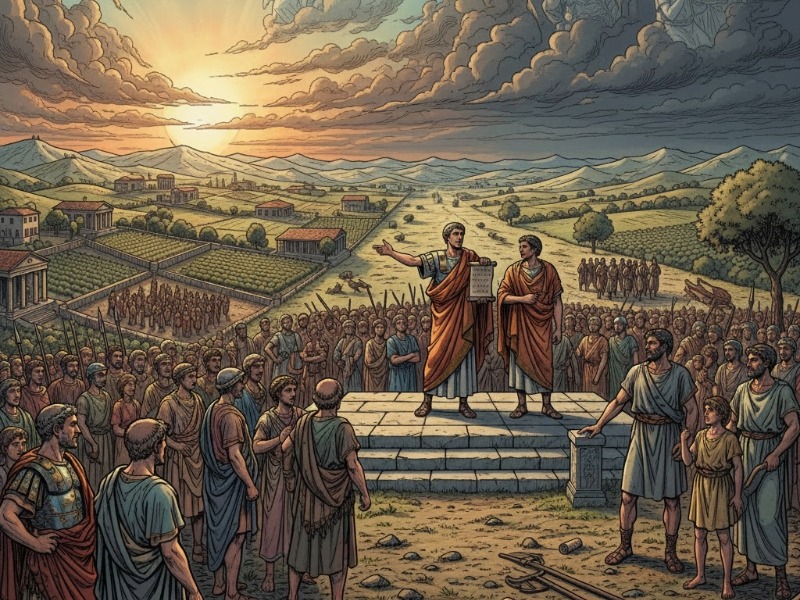
The first major disputes over public land emerged early in the Roman Republic. Conflict arose between patricians and plebeians concerning access and usage. Eventually, the Licinio-Sextian Laws of 367 BCE established a possession limit. This law stated that no citizen could occupy more than 500 iugera of the land. However, the powerful elite often ignored or circumvented this restriction. Therefore, this widespread illegal occupation created large, slave-worked estates called latifundia. Significantly, this concentrated land ownership led to a critical shortage of small, independent farmers. Consequently, this crisis spurred the agrarian reforms proposed by the Gracchi brothers in the 2nd century BCE. Their attempts to reclaim and redistribute the land resulted in political violence. This entire episode clearly highlighted the deep social divisions within the late Republic.
Social Context of Ager Publicus
Public land policy strongly influenced the social structure and stability of Rome. Many poor, landless citizens relied on access to this property for survival and social status. Holding land was a fundamental requirement for military service in the Roman legions. Consequently, the loss of land contributed to the growing ranks of Rome’s urban poor (proletarii). The potential for land grants became a powerful political tool for generals. Moreover, generals like Marius, Sulla, and Caesar used land to secure the loyalty of their veteran armies. Furthermore, the continuous struggle over this land shaped the identity of both the optimates (aristocrats) and the populares (reformers).
| Area of Influence | Significance and Impact |
| Roman Colonial System | The acquisition and distribution of Ager Publicus was essential for the rapid expansion and establishment of the Roman colonial system. |
| Agricultural Practices | The state’s policy of leasing Ager Publicus influenced agricultural practices across Italy, promoting the use of slave labor on large cash-crop farms. |
| Preservation of Records | Records relating to centuriation (land surveying) of the ager limitatus are preserved in legal fragments and archaeological landscapes, outlining state boundaries. |
| Core Economic Debate | Disputes over the land defined the core economic debate between the ruling class and the popular assembly for centuries. |
Terms Related to Ager Publicus
The public land system involved numerous legal, technical, and political concepts throughout Roman history. Understanding these related terms provides essential context for the land’s impact on Roman society. This provides a clearer view of the legal framework surrounding Roman state property.

| Term/Concept | Description and Relevance |
| Latifundia | The large, private estates, often illegally expanded through the occupation of Ager Publicus, for example. |
| Lex Sempronia Agraria | The agrarian law of 133 BCE, introduced by Tiberius Gracchus, aimed at enforcing the 500 iugera limit and redistributing land. |
| Vectigal | The rent or tax paid to the state by those leasing or occupying parts of the Ager Publicus, generating state revenue. |
| Iugerum | The primary Roman unit of land area, roughly 0.62 acres, used for measuring and allocating plots. |
| Centuriation | The grid system of surveying and dividing the land, still visible archaeologically in some former Roman territories. |
| Possessores | The technical term for those who were occupying the Ager Publicus, legally or illegally. |
Sources & Credits
Sources
- Britannica, T. Editors of Encyclopaedia. “Ager publicus.” Encyclopedia Britannica. [Definition site]
- Cornell University Law School. “Lex Sempronia Agraria.” Legal Information Institute. [Government institutional body/definition site]
- Harris, W. V. “War and Imperialism in Republican Rome 327-70 B.C.” Oxford University Press, 1979. [Historical source]
- Purcell, N. “The Roman Agrarian Problem: The Case of the Gracchi.” The Cambridge Ancient History, Vol. VIII: Rome and the Mediterranean to 133 B.C. Cambridge University Press, 1989. [Historical source]
- Metropolitan Museum of Art (The Met). “Ara Pacis Augustae (Altar of Augustan Peace).” Heilbrunn Timeline of Art History. [Museum site]