Table of Contents: Definition – Agora
“Agora “
Term: Agora
Pronunciation: /ˈæɡərə/ (AG-uh-ruh)
Part of Speech: Noun
Agora Definition (Greek Context):
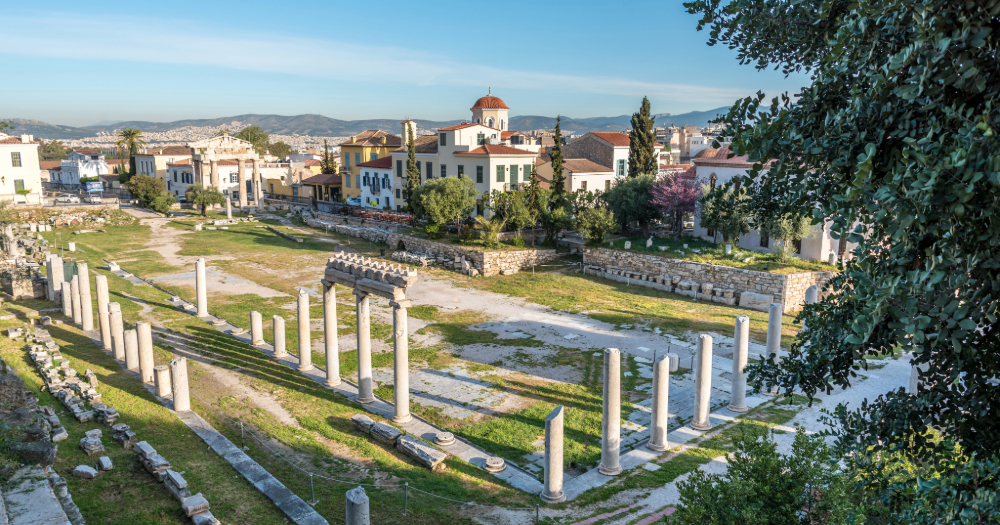
The agora was a central public open space in ancient Greek city-states. It served as the heart of civic life, functioning as a marketplace for commerce, a gathering place for social interaction, a venue for political assemblies and judicial proceedings, and often the site of religious shrines and gymnasia. The forum was the focal point of community life, embodying the social, political, and economic activities of the polis.
Origin of the Word “Agora”:
The term “agora” (ἀγορά) comes from the ancient Greek verb ageirein (ἀγείρειν), meaning “to gather” or “assemble.” This directly reflects the forums primary function as a meeting place.
Examples:
General Use: “Citizens would gather in the agora to discuss the latest news and conduct business.”
Archaeological Context: “The ruins of the Athenian Agora reveal the foundations of temples, stoas, and public buildings.”
Historical Context: “Philosophers like Socrates often engaged in discussions with the public in the agora.”
Political Context: “Important political debates and votes took place in the open space of the agora.”
Vocabulary and Language Resources
Terms Related to Agora
- Acropolis: The “high city,” often a fortified hill containing important temples and public buildings, overlooking the agora.
- Stoa: A long, colonnaded building bordering the forum, providing shelter and spaces for shops and gatherings.
- Bouleuterion: The council house where the citizen council (boule) met.
- Tholos: A round building, often used as a prytaneion (executive committee headquarters) or a treasury.
- Gymnasium: A public facility for athletic training and social interaction, sometimes located near the agora.
- Temple: A building dedicated to a god or goddess, often situated within or near the agora.
Etymology
From ancient Greek ἀγορά (agorá), from ἀγείρειν (ageírein), “to gather,” “assemble.”
Synonyms
Marketplace, public square, assembly place, forum (Roman equivalent, though with slightly different connotations).
Antonyms:
Private space (e.g., oikos – household), secluded area.
Thesaurus
Plaza, square, forum, marketplace, gathering place, public area, precinct, center.

Agora Historical & Cultural Context:
The agora evolved from a simple open area to a complex urban center over time. In early Greek history, it was primarily a gathering place for the community. As the polis developed, the plaza became more formalized, with the construction of stoas, temples, and other public buildings around its perimeter. The Athenian Agora is one of the most well-studied examples, revealing a history spanning centuries and showcasing its central role in Athenian democracy, philosophy, commerce, and social life. The plaza was not just a physical space but also a social and political institution, reflecting the values and organization of the Greek city-state.
Principles or Key Aspects of Agoras:
- Central Public Space: Located in the heart of the polis.
- Multifunctional: Served economic, social, political, and sometimes religious purposes.
- Gathering Place: A key location for citizens to interact and assemble.
- Urban Center: Often surrounded by important civic and commercial buildings.
- Symbol of the Polis: Represented the community and its activities.
Ethical Considerations for Agoras:
- Representation of Public Life: Understanding who had access and participated in the agora.
- Interpretation of Commerce: Considering the ethical aspects of trade in the ancient world.
Relevance to Ancient Worlds
The agora is crucial for understanding ancient Greece because it:
- Embodied Civic Life: Was the physical and social center of the polis.
- Facilitated Democracy: Served as the primary assembly place for citizens.
- Promoted Commerce: Was the main marketplace for goods and services.
- Fostered Social Interaction: Provided a space for people to meet and converse.
- Shaped Urban Development: Its layout influenced the organization of the city.