Table of Contents: Definition – Kouros
“Kouros “
Pronunciation: /ˈkuːrɒs/ (KOO-ross)
Part of Speech: Noun
Plural: Kouroi
Kouros Definition:
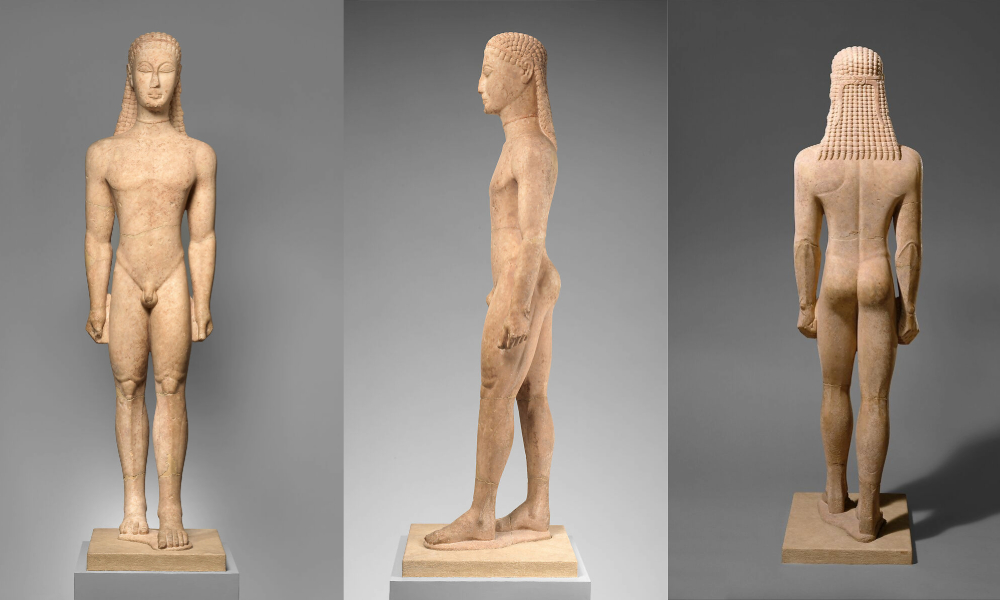
A kouros is a modern term for a type of free-standing ancient Greek sculpture that depicts a nude male youth. Predominant during the Archaic period (c. 7th to early 5th centuries BCE), kouroi are characterized by a rigid, frontal stance, with the left leg typically advanced slightly, arms held straight at the sides with clenched fists, and an idealized, often somewhat geometric, representation of the human form. These life-sized (or sometimes colossal) marble statues served various functions, including grave markers, votive offerings in sanctuaries, and representations of deities or heroes.
Origin of the Word “Kouros”:
The term “kouros” is the ancient Greek word (κοῦρος) for “youth” or “young boy.” Modern scholars adopted this term to categorize this specific style of Archaic sculpture. The ancient Greeks themselves did not have a single term for these statues.
Examples:
General Use: “The museum displayed a striking kouros from the Archaic period.”
Archaeological Context: “Several kouroi have been discovered in sanctuaries dedicated to Apollo.”
Art History Context: “The kouros represents a significant stage in the development of Greek sculpture, moving towards more naturalistic forms.”
Religious Context: “Some kouroi are believed to have represented the god Apollo or served as dedications to deities.”
Funerary Context: “Many kouroi were found in cemeteries, likely functioning as grave monuments for aristocratic youths.”
Vocabulary and Language Resources
Related Terms
- Kore (κόρη): The female equivalent of the kouros, depicting a standing, draped maiden.
- Archaic Smile: The characteristic enigmatic smile seen on many kouroi and korai.
- Votive Offering: A gift dedicated to a deity in a sanctuary.
- Grave Marker: A monument placed at a burial site.
- Canon of Proportions: A set of rules governing the ideal measurements of the human body, which influenced the kouros form.
Etymology
From ancient Greek κοῦρος (koûros), meaning “youth.”
Synonyms
Standing nude youth (descriptive).
Antonyms
Kore (standing draped maiden), portrait statue (later Greek sculpture aimed at likeness).
Thesaurus
While “kouros” is specific, related concepts include: statue, sculpture, effigy, representation, monument.

“Kouros” Historical & Cultural Context:
The emergence of the kouros in the Archaic period coincided with renewed contact between Greece and Egypt in the 7th century BCE, with the monumental scale and rigid frontal pose showing Egyptian influence. However, unlike Egyptian statues which were often attached to a back slab or depicted deities and rulers, kouroi were free-standing and could represent gods, heroes, or commemorated individuals. They were primarily made of marble and found across the Greek world, with notable concentrations in Attica and Boeotia. Over time, the kouros evolved, with sculptors gradually incorporating a greater understanding of human anatomy, moving away from the more geometric forms of the early Archaic period towards a more naturalistic representation by the late Archaic and early Classical periods. The function of the kouros was multifaceted, serving religious, commemorative, and possibly even symbolic purposes, representing ideal youth and aristocratic virtue.
Principles or Key Aspects of the Word Kouros:
- Frontal Pose: Standing straight with arms at the sides.
- Nudity: Typically depicted without clothing, emphasizing the idealized male form.
- Left Leg Forward: A conventional stance suggesting potential movement, though the figure remains rigid.
- Clenched Fists: Hands held tightly at the sides.
- Idealization: Representing a youthful ideal rather than a specific individual likeness in early examples.
Ethical Considerations for Kouros:
- Interpretation: Understanding the original context and intended meaning of these statues.
- Display: Presenting these often-sacred or funerary objects respectfully in museum settings.
- Provenance: Ensuring that any study or display involves ethically sourced examples.
Relevance to Ancient Worlds
The kouros is crucial for understanding:
- Archaic Greek Art: Representing a defining sculptural form of the period.
- Religious Practices: Serving as votive offerings in sanctuaries.
- Funerary Customs: Marking the graves of prominent individuals.
- Social Values: Reflecting aristocratic ideals of youth, athleticism, and beauty.
- The Development of Greek Sculpture: Showing the transition from more stylized to more naturalistic representations of the human form.
Art2Fact Society Nuance
For the Art2Fact Society, the kouros embodies the ancient Greek pursuit of ideal form and the powerful symbolic potential of the human figure. Its timeless representation of youth and strength can serve as a potent source of inspiration for contemporary artists exploring similar themes. By studying the kouros, its evolution, and its various functions, the Society can gain a deeper appreciation for the enduring human fascination with the body as a subject of artistic expression and a vehicle for conveying cultural values within the “ancient revival project.” The kouros invites a dialogue between ancient ideals and modern interpretations of the human form and its symbolic resonance.