AUGUSTUS (FIRST ROMAN EMPEROR)
63 BCE – 14 CE
Table of Contents

Gaius Octavius Thurinus, used the name Caesar after adoption.

Born in Rome, Roman Republic, though family originated near Velitrae.

His reign as Princeps (First Citizen) lasted from 27 BCE – 14 CE.

He was the principal heir and adopted son of Julius Caesar.

Granted the honorary and religious name Augustus (“The Revered One”).

He established the Pax Romana (Roman Peace), lasting for two centuries.

His forces decisively defeated Antony and Cleopatra at Actium (31 BCE).

He oversaw a massive building program, transforming Rome from brick to marble.

| He was officially consecrated and declared a Roman God (Divus Augustus). |
Overview
Augustus was born with the name Gaius Octavius in 63 BCE. He was a great-nephew of the famous Julius Caesar. Caesar’s will designated him as the main heir in 44 BCE. This inheritance launched him into the dangerous world of Roman politics. He immediately allied himself with Mark Antony and Marcus Lepidus. They formed the Second Triumvirate. After defeating Caesar’s assassins, the alliance soon broke down into civil war. This conflict culminated in the Battle of Actium in 31 BCE. Octavian’s victory over Antony and Cleopatra solidified his control over Rome.
The most critical step was the First Settlement of 27 BCE. Here, he kept his actual power but relinquished the title of Triumvir. Meanwhile, he was granted the honorary title Augustus by the Senate. He built a vast administrative system and a standing army. He focused on securing Rome’s frontiers, especially in Germania and the Danube region. His long rule marked a golden age for Roman literature, called the Augustan Age. Virgil and Horace were key figures of this time. He died in 14 CE after a lengthy and successful period of stability.

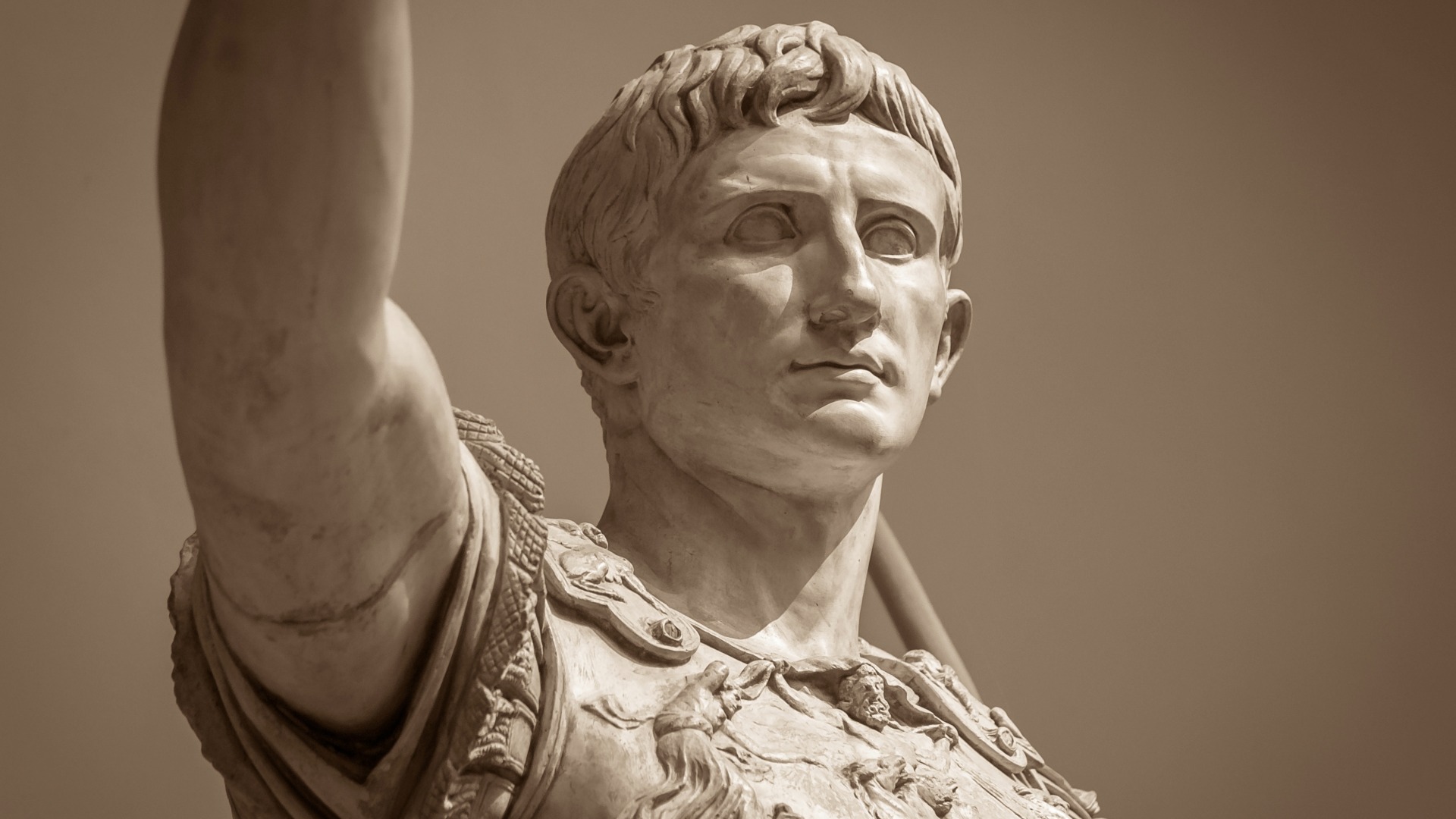
The famous Prima Porta statue served as powerful, idealized imperial propaganda.

Plagued by early deaths of his preferred male heirs; he reluctantly chose his step-son Tiberius.

| He suffered from chronic poor health throughout his life, requiring special clothing due to sensitivity to cold. |
Timeline of Augustus
| Year (BCE/CE) | Event | Significance |
| 63 BCE | Born Gaius Octavius. | Heir to a respected, though not particularly prominent, family. |
| 44 BCE | Julius Caesar assassinated. | Octavius named Caesar’s principal heir in his will. Thus, his political rise starts. |
| 43 BCE | Second Triumvirate formed. | Octavian forms an alliance to defeat Caesar’s assassins. |
| 31 BCE | Battle of Actium. | Octavian defeats the forces of Mark Antony and Cleopatra, securing undisputed control. |
| 27 BCE | First Settlement and title Augustus. | The official start of the Roman Empire and the Pax Romana. |
| 14 CE | Death of Augustus. | Succeeded by Tiberius, cementing the imperial system. |

Legacy of Augustus
Augustus’s creation of the imperial office and the accompanying political structure proved remarkably resilient. It endured for centuries as the blueprint for Roman governance. His sweeping reforms in governance, infrastructure, and the military were fundamental to the Empire’s success, providing a foundation that subsequent emperors relied upon. He famously stated he “found Rome a city of brick and left it a city of marble,” a testament to the extensive public works he commissioned, including the rebuilding of over eighty temples and the construction of his own forum. Ultimately, his greatest achievement was transforming a chaotic, war-torn Republic into a durable, peaceful Empire, forever known as the Pax Romana. This long period of peace and prosperity defined the Roman Golden Age.
More
| Date/Period | Aspect of Legacy | Detail |
| 27 BCE – 180 CE | Pax Romana | Period of relative peace and minimal expansion initiated by his reign. |
| 29 BCE – 14 CE | Building Program | Rebuilt over eighty temples; initiated the Forum of Augustus. |
| 44 BCE – 14 CE | Imperial Office | Established the constitutional framework for Roman Emperors that endured for centuries. |

Major Reforms: Augustus
Augustus was a meticulous administrator who thoroughly overhauled the Roman system of governance. Augustus created a centralized treasury (Aerarium Saturni), consolidating the state’s chaotic finances and increasing transparency and efficiency in tax collection. He replaced the corrupt system of tax farming with a new, salaried bureaucracy—the professional civil service—composed of freedmen and equestrians loyal to him, thereby securing his administrative control. He also established the vigiles, a permanent police and fire-fighting force for Rome, improving urban safety dramatically. Indeed, to facilitate commerce and administration across the vast empire, he standardized the coinage and implemented a comprehensive census. These deep and lasting changes ensured stability and efficient resource management.
More
| Date/Period | Nature of Reform | Outcome |
| 27 BCE – 14 CE | Administrative | Established the salaried Professional Civil Service (replacing old patronage). |
| 27 BCE | Financial | Created the Aerarium Saturni (centralized treasury) to stabilize state funds. |
| 6 CE | Public Safety | Instituted the Vigiles (permanent fire and police force in Rome). |
| 28 BCE | Census | Implemented a comprehensive census for fair taxation and military enrollment. |

Influence: Augustus
Augustus’s sphere of influence was secured and defined by his absolute control over the military. He maintained a large, professional standing army of twenty-eight legions, removing the threat of private armies that had plagued the Republic. He used this powerful, unified force primarily to secure the borders (or limes), strategically consolidating Roman territory rather than pursuing constant, costly expansion. His original goal was to achieve imperium sine fine (rule without end), but he accepted practical limits after the devastating defeat in the Teutoburg Forest in 9 CE, where three legions were lost. However, by stabilizing the borders along the Danube and Rhine rivers, he defined the core frontiers of the Western Empire for generations.
| 30 BCE – 2 CE | Military Restructuring | Established the standing army (28 legions) and loyalty to the Emperor. |
| 9 CE | Strategic Retrenchment | Teutoburg Forest Defeat led to defining the Rhine-Danube frontier. |
| 27 BCE – 14 CE | Territorial Policy | Focus on securing existing borders (limes) rather than rapid expansion. |