Table of Contents: Larimar Stone
“Larimar Stone”
Pronunciation: la-ree-mar
General use: Promoting clear communication from the heart, alleviating stress, and connecting with the divine feminine.
Location: Found exclusively in a single square kilometer in the mountains of Barahona, Dominican Republic.
Time Period: Rediscovered in 1974 by Miguel Méndez, who named it after his daughter (Larissa) and the Spanish word for sea (Mar).
Quick Facts
| Varieties | Blue Volcanic Pectolite, Sky Blue Larimar, Volcanic Larimar, Green Larimar (rare) |
| Chakra Alignment | Throat, Third Eye, and Crown Chakra |
| Affirmation | I flow with the calm of the ocean and express my truth with grace and ease. |
| Vibration Number | Number 55 |
| Element | Water and Fire |
| Planet | Neptune |
| Zodiac Sign | Leo and Pisces |
| Birthstone | Not traditionally assigned |
| Metaphysical Realm | Emotional and Spiritual |
| Benefits | Calm, Communication, Stress Relief, Emotional Healing, Enlightenment, Peace |
| Cleansing | Moonlight, Selenite, or Brief Water Rinse. Avoid long sunlight exposure. |
| Mineral Class | Silicate (Acid Sodium Calcium Pectolite) |
| Chemical Formula | NaCa2Si3O8(OH) / NaCa2Si3O8(OH) |
| Crystal System | Triclinic |
| Mohs Hardness | 4.5 to 5 |
| Primary Color | Sky Blue to Deep Caribbean Blue with White Marble patterns |
| Transparency | Translucent to Opaque |
| Lustre | Vitreous to Silky |
| Refractive Index | 1.59 to 1.63 |
| Specific Gravity | 2.74 to 2.90 |

ART: Master jewelers often cut Larimar into organic, rounded shapes or teardrops to mimic the appearance of sunlight reflecting off the Caribbean sea floor.

HIDDEN TRUTH: Local legends in the Dominican Republic suggest that Larimar originated from the lost city of Atlantis, leading to its nickname, the “Atlantis Stone.”
FACT:Although Larimar is a Pectolite, its unique blue color comes from copper replacing calcium in the crystal structure; most other Pectolites found globally are gray or white.
Did you know?
Did you know that Larimar is one of the only gemstones found in the entire world that is formed within volcanic pipes, created by the cooling of hot gases and mineral-rich fluids?
I. Geological Overview of Larimar Stone
Larimar Stone is a rare blue variety of Pectolite that occurs in basaltic lavas in the Dominican Republic. It forms when copper-rich hydrothermal fluids circulate through cavities and cracks in the volcanic rock, depositing microcrystalline aggregates. Unlike common Pectolite, which is often brittle and white, the presence of copper gives Larimar its distinctive sky-blue hues and durable, compact structure. The intricate white patterns within the stone are caused by the presence of calcite and the way the mineral crystallized within the volcanic host rock.
II. Traditional Applications of Larimar Stone
While the stone was likely known to the indigenous Taino people, it has no long-standing historical record in ancient jewelry due to its recent rediscovery. In modern times, it has become the national stone of the Dominican Republic and is a staple in Caribbean luxury jewelry. Beyond its aesthetic appeal, Larimar is highly sought after by metaphysical practitioners for “Dolphin breathing” exercises and vocal therapies, as its frequency is thought to resonate with the sound of the ocean.

III. Holistic Properties & Healing Benefits of Larimar Stone
Larimar Stone provides comprehensive holistic benefits by acting as a powerful frequency for emotional cooling and spiritual expansion. It functions across multiple planes:
- Physical Level: Practitioners believe it assists in clearing blockages in the chest, neck, and head area, while also utilizing it to soothe inflammation and reduce the intensity of “hot flashes” or fevers.
- Mental Level: The stone acts as a tool for “cognitive cooling,” helping the user to detach from repetitive, stressful thought patterns and encouraging a state of fluid, creative playfulness.
- Emotional Level: It acts as a primary stabilizer for the “Inner Child,” replacing feelings of fear and self-doubt with a nurturing, maternal sense of security and peace.
- Spiritual Level: It facilitates a connection to the Angelic realms and the Divine Feminine, encouraging the user to recognize their own divinity and to speak with the authority of the soul.
Metaphysically, the stone’s Triclinic System reflects an energy of “non-linear” healing, allowing for the resolution of complex, multi-layered emotional issues. Furthermore, the Sea-Foam Patterns of Larimar are spiritually interpreted as a reminder of the constant flow of the universe and the power of surrender. Because the stone possesses a Vitreous to Silky Lustre, it is energetically used to “soften” a hardened heart. Additionally, its Copper Content serves as a conductor for higher frequencies, while the White Striations act as filters that purify the user’s intent before they speak.
IV. Care and Use of Larimar Stone
Proper care for the Larimar stone involves protecting its relatively soft surface and clearing the “heat” of the emotions it absorbs during its cooling work. Owners must recognize that Larimar is sensitive to light and chemicals, meaning it should never be cleaned with harsh detergents or left in direct sunlight for extended periods.
- Cleansing/Clearing: You should clear your Larimar by passing it through the smoke of white sage or lavender to refresh its connection to the “Air” element. Alternatively, you can utilize the moonlight method by placing the stone on a windowsill during a Full Moon to wash away the energetic residue of heavy communication.
- Charging: You can charge your Larimar stone by placing it in a bowl of cool, purified water for 15 minutes; this “Water” element recharge revitalizes its oceanic frequency. Furthermore, you may place the stone on a Selenite charging plate for six hours to re-align its spiritual connection to the higher heart and throat chakras.
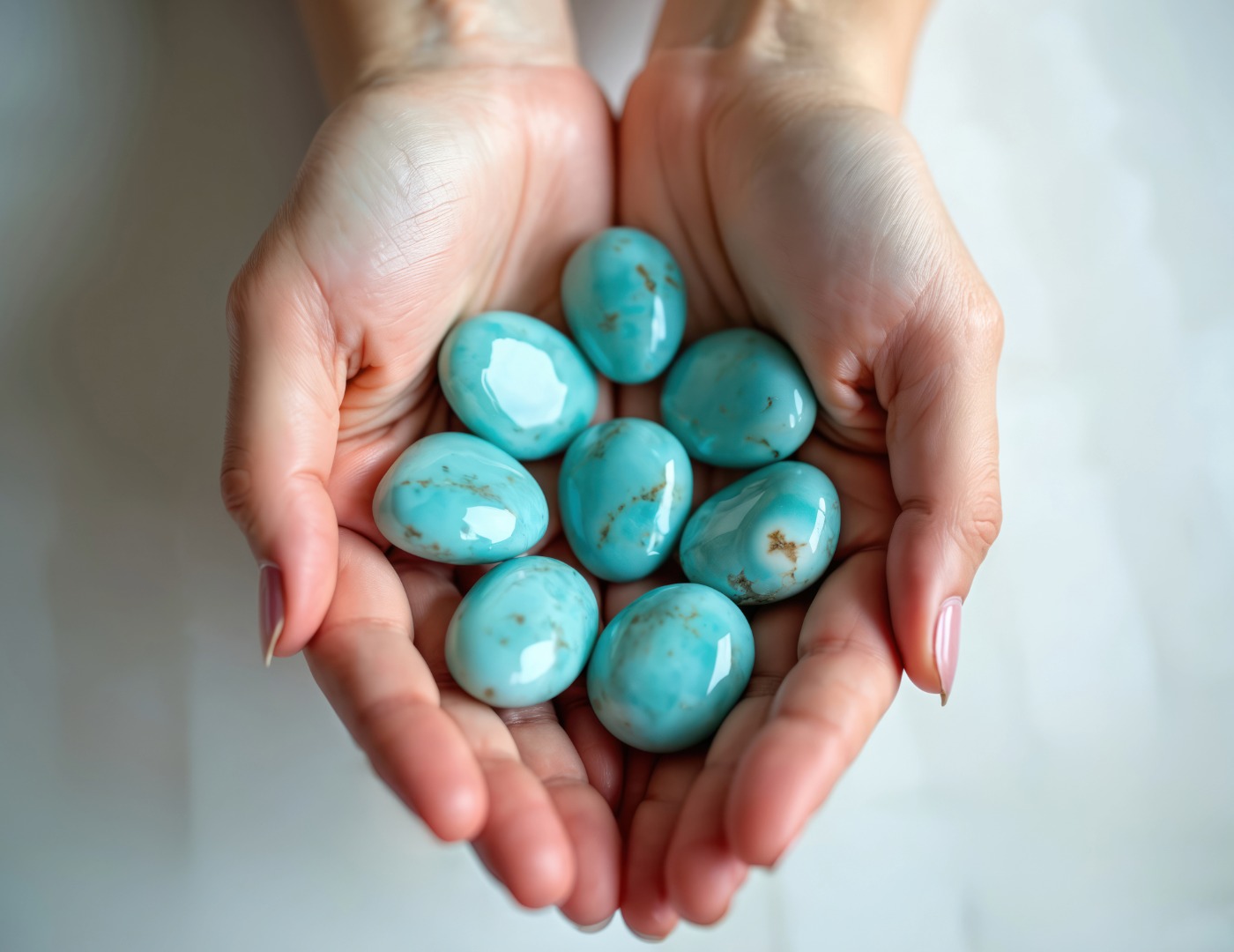
- Intentional Use: You should hold the Larimar over your throat during a five-minute visualization while imagining a blue wave of peace washing away any words you have left unsaid; the stone will “store” this frequency of honest expression. Additionally, you may utilize the stone in the bathtub to create a “spa-like” energetic environment that promotes deep physical and emotional relaxation.
V. History of Larimar Stone
The history of Larimar Stone is relatively modern, beginning with a brief mention in 1916 by a local priest, though the request to mine it was initially denied. It wasn’t until 1974 that Miguel Méndez and a Peace Corps volunteer named Norman Rilling found blue stones on a beach and traced them upstream to the volcanic mountain source. Since then, Larimar has risen to global fame as one of the rarest and most localized gemstones on the planet, with its limited supply and single-source origin making it a highly prized collector’s item.
VI. Crystallography of Larimar Stone
| Crystal System | Triclinic: Forming as fibrous aggregates or massive veins within volcanic basalt cavities. |
| Fibrous Habit | The needle-like growth of pectolite creates the stone’s distinctive “shimmering” sea-foam appearance. |
| Copper Substitution | The presence of copper replacing calcium provides the unique turquoise and sky-blue color signatures. |
| Refractive Index | 1.595 – 1.645: A moderate index that contributes to its soft, translucent glow and watery lustre. |
| Birefringence | 0.030 – 0.038: A high birefringence that supports the stone’s ability to shift emotional perspectives. |
| Optical Character | Biaxial Positive: Reflects a multi-directional energy flow that assists in complex throat chakra work. |
| Specific Gravity | 2.74 – 2.90: A lightweight density that corresponds with the “Water” element and emotional buoyancy. |
| Fracture Type | Subconchoidal: Breaks with smooth, curved surfaces, reflecting its fine-grained and volcanic nature. |
| Lattice Structure | Inosilicate: A single-chain silicate structure that represents the “uninterrupted flow” of truth. |
| Photosensitivity | Moderate: The blue color can fade under intense UV rays, representing the stone’s “delicate” and “private” nature. |
Sources & Credits
Sources
- Mindat.org, Hudson Institute of Mineralogy. Larimar (Blue Pectolite) Mineral Data and Localities
- The Gemological Institute of America (GIA). Larimar: The Blue Pectolite of the Dominican Republic
- The Smithsonian Institution. The Geology of Inosilicates: Pectolite and Copper Substitution in Larimar
- “The Book of Stones” by Robert Simmons & Naisha Ahsian. The use of Larimar for serene communication and emotional cooling (Source for Section III and IV).
- American Mineralogist. The Crystal Chemistry of Pectolite and the Cause of Blue Color in Larimar (Scientific verification of mineral mechanics).
- “Love is in the Earth” by Melody. Metaphysical properties of Larimar for connecting with Atlantis and the Goddess (Source for Section III).